

Introduction
Giotto di Bondone is often heralded as the artist who paved the way for the Renaissance. His revolutionary approach to painting broke away from the rigid, stylized figures of medieval art, introducing a newfound realism that emphasized human emotion, spatial depth, and natural movement. By infusing his works with a sense of three-dimensionality and life-like expressions, he forever changed the course of Western painting. His contributions marked the transition from the Byzantine tradition to the naturalistic approach that would define the art of the Renaissance.
As the father of Western painting, Giotto’s impact cannot be overstated. His mastery of perspective and his ability to depict human emotion in a realistic and compelling manner laid the groundwork for artists like Masaccio, Michelangelo, and Raphael. This article explores his life, artistic breakthroughs, and the lasting legacy that cemented his place as one of history’s most influential painters.
Early Life and Background
Born around 1267 in the Republic of Florence, Giotto’s origins are somewhat obscure, with myths and historical accounts often blending together. A widely accepted legend suggests that he was discovered as a young shepherd boy by the renowned painter Cimabue, who saw Giotto sketching lifelike figures on a rock. Recognizing his innate talent, Cimabue took him under his wing as an apprentice. While the story may be romanticized, what remains certain is that Giotto’s artistic abilities quickly surpassed those of his teacher, signaling the dawn of a new era in painting.
During Giotto’s formative years, medieval art was heavily influenced by Byzantine traditions, characterized by rigid compositions, gold backgrounds, and a lack of perspective. Figures appeared flat, with little to no interaction between them. However, Giotto began to challenge these conventions. He sought to portray the human form with a sense of physicality and weight, making his figures appear grounded in their environment. He also emphasized emotional expressiveness, allowing viewers to connect with his subjects on a more profound level.
Comparison with Byzantine Art
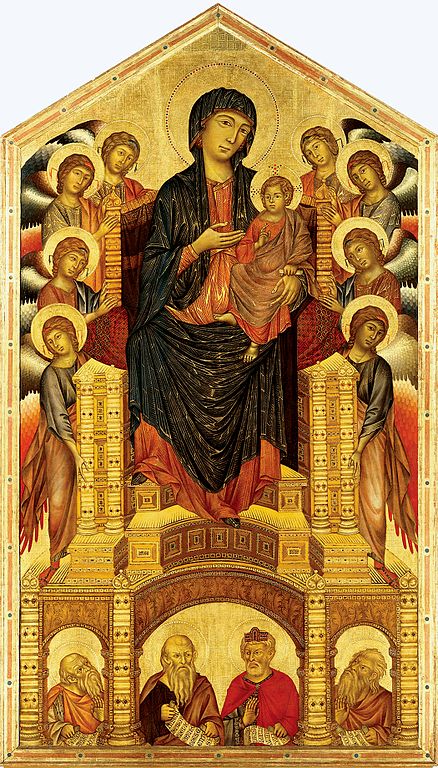
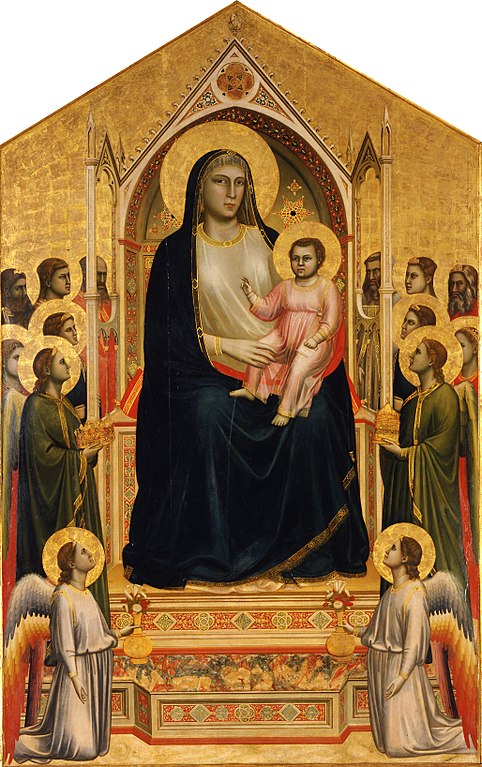
Byzantine art, which dominated European religious painting before Giotto, featured flat figures with stylized, elongated forms and little concern for naturalism. Giotto’s work, in contrast, introduced volumetric bodies, the illusion of space, and emotional storytelling. A comparison between Giotto’s Ognissanti Madonna (see further in the article) and earlier Byzantine icons, such as the Madonna and Child Enthroned (seen below) by Cimabue, highlights this dramatic shift in style and intent.
Giotto’s early exposure to religious narratives and his deep understanding of human emotion would later become central to his artistic vision. His ability to breathe life into sacred stories and render them in a relatable, tangible manner distinguished him from his predecessors and set the stage for the artistic revolutions to come.
Breaking from Tradition: Giotto’s Artistic Innovations
Giotto’s departure from the Byzantine style was groundbreaking. Where earlier medieval art emphasized a symbolic and spiritual representation of figures, Giotto sought to depict people as they truly were—physical beings with depth and movement. He introduced several key artistic innovations that would shape the course of Western painting:
- Three-Dimensional Figures: Unlike the flat, elongated figures typical of Byzantine art, Giotto painted human forms with volume and weight, giving them a natural sense of presence.
- Chiaroscuro (Light and Shadow): He experimented with shading and highlights to create depth, making figures appear more lifelike and grounded.
- Emotional Expression: His characters displayed a range of emotions—grief, joy, contemplation—making religious narratives more engaging and human.
- Naturalistic Space and Perspective: Giotto arranged figures in a way that suggested a real spatial environment, pioneering techniques that would later be refined by Renaissance masters.
- Dynamic Composition: He broke away from the rigid symmetry of earlier paintings, instead arranging figures dynamically to create movement and storytelling.
These innovations marked the beginning of a new artistic approach, moving away from strict religious symbolism and toward a more naturalistic, observational style. Giotto’s ability to bring stories to life through expressive human figures and realistic environments solidified his role as a transformative force in art history.
Major Works and Their Impact
Frescoes of the Scrovegni Chapel (Arena Chapel, Padua)
One of Giotto’s most celebrated achievements is the fresco cycle in the Scrovegni Chapel, completed around 1305. These frescoes depict the life of the Virgin Mary and Christ in a series of compelling, emotionally charged scenes.
- The Lamentation: This fresco is one of the most famous within the chapel, showcasing Giotto’s revolutionary approach to human emotion. The grieving figures, arranged with a striking diagonal composition, exude sorrow and depth in a way unprecedented in medieval art. The use of foreshortening and spatial arrangement guides the viewer’s eye naturally across the scene, creating an immersive experience.

- The Kiss of Judas: Another masterpiece from the chapel, this fresco captures the dramatic moment of betrayal. The intense gaze between Christ and Judas, combined with the dynamic gestures of the surrounding figures, creates an arresting visual narrative.

Ognissanti Madonna (Madonna Enthroned)
Painted around 1310, this altarpiece represents a pivotal shift from the Byzantine tradition. Unlike earlier depictions of the Madonna, Giotto’s figures are more voluminous, with a noticeable sense of weight and presence. The throne is rendered with an early use of perspective, providing a more believable architectural space. This work would later influence Renaissance masters in their pursuit of realism.
The Bardi Chapel Frescoes (Santa Croce, Florence)
Commissioned by the wealthy Bardi family, this series of frescoes illustrates the life of St. Francis of Assisi. Giotto’s ability to capture the emotional depth of St. Francis’s journey elevates these frescoes beyond simple religious storytelling. His use of individualized expressions, physical gestures, and narrative composition makes these paintings some of the most powerful works of early Renaissance art.
Legacy and Final Years
In his later years, Giotto continued to work on prestigious commissions, including frescoes in Naples and Bologna. In 1334, he was appointed chief architect of Florence Cathedral, a testament to his broad influence beyond painting. His architectural contributions, though less documented, further showcase his innovative spirit. The structural developments he influenced, including aspects of spatial awareness and design, would foreshadow later Renaissance architectural masterpieces. Giotto passed away in 1337, leaving behind a legacy that shaped the future of Western art.

Conclusion
Giotto di Bondone was a transformative figure in art history, bridging the gap between medieval and Renaissance artistic traditions. His pioneering approach to realism, perspective, and emotional depth set a new standard for painters to follow. His legacy continues to inspire modern artists, emphasizing the timeless relevance of human expression and naturalism in visual storytelling. His influence echoes through the works of the greatest Renaissance masters, ensuring his place as one of the most pivotal figures in Western art.
Leave a Reply