

By Lee Down, Founder of Arts Artists Artwork
Researched and written June 2026 upon request of CPSA magazine, where a shorter version will be published.
Opening
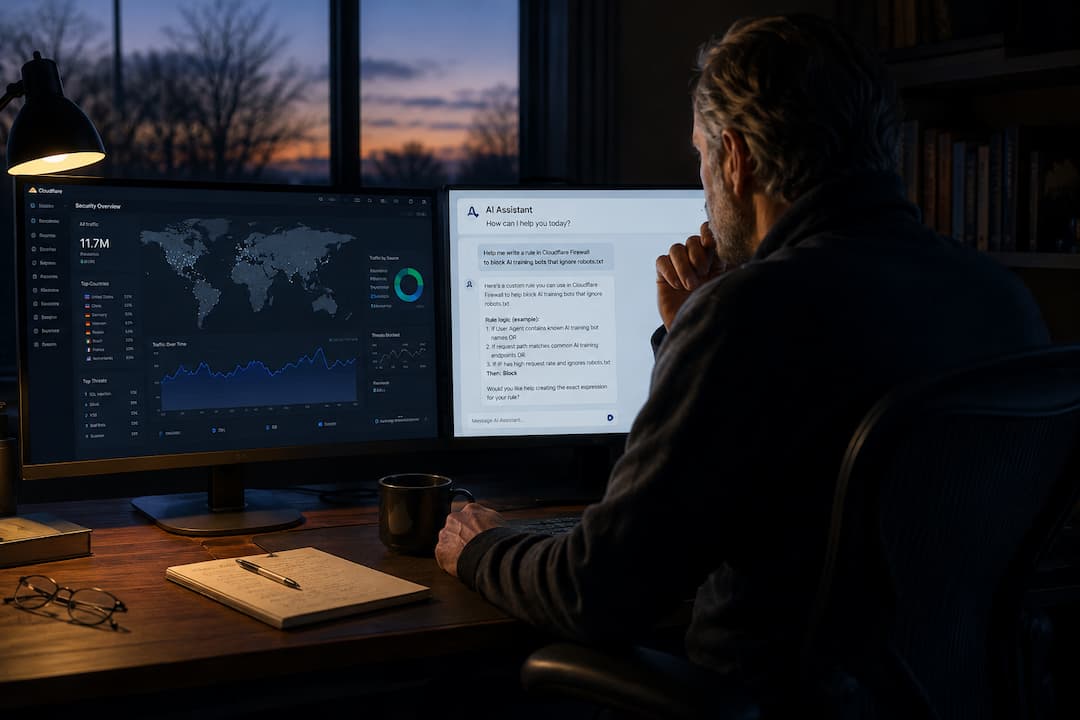
Most mornings, before anything else, I log in to a dashboard that tells me who tried to break into my website overnight.
Bots, mostly. Thousands of them, from every corner of the world, probing the locks. Some want to take the site down for sport. Others want something quieter and, to me, more unsettling: they want the artwork. They want to copy the images my artists have entrusted to me, pour them into a machine, and teach that machine to produce more work that looks like theirs — endlessly, without asking, without paying. A good part of my week goes to keeping those particular visitors out.
And then, more often than I would have predicted three years ago, I open another window and ask a machine to help me think.
That is the knot I have not been able to untie. I run a marketplace built to put money in artists’ pockets and their names in front of the world, and I spend real hours defending their images from the very kind of technology I have come to lean on. If that sounds like hypocrisy, I understand why. I’ve turned it over enough times to know it isn’t — but I’ve also stopped reaching for a tidy way to say so.
Here is the honest version. I am not conflicted about AI because it exists. I’m conflicted about how it was built. For these systems to be any good, they had to be trained, and they were trained on us — on our books, our paintings, our photographs, our words — most of it taken without a knock on the door. Were they right to steal content to train their systems? Morally, no. But maybe, practically, they were, because without that vast and uninvited harvest the tools would be a fraction of what they are. There’s the dilemma I can’t find peace with, sitting right there in the middle of the thing. Creators should have been compensated. Creators should have been asked.
I’d love to stop there, righteous and done. I can’t, because I use it. Not to paint. Not to sign my name to pictures a machine made. But to brainstorm, to untangle a technical mess no one else could help me with, to push a sentence until it finally says what I meant. And the truth of it is, the tools arrived at a moment when a lot of people — people carrying ideas they could never quite execute on their own — found a door open that had always been shut to them. For some of them it has been less a threat than a lifeline. I’ll come back to them, because they changed how I see this.
So I’m not going to pretend I’ve sorted it out. I haven’t. What I can offer is the view from where I stand: an art marketplace founder doing two contradictory things at once — keeping the machine out with one hand, quietly using it with the other — trying to see the whole thing clearly. I’m not here to change anyone’s mind. I’m here to walk you through what I’ve come to learn, eyes open, over the last three years.
Let’s start with what’s true.
The grievances are real
If you only know the AI conversation from social media, you might come away thinking the people upset about it are being precious. They are not. The core grievance is simple and, as far as I can tell, entirely legitimate: the companies that built these systems scraped the internet — artwork, writing, photography, journalism, music — and fed it all into their models without permission and without paying a cent for it. Whatever you think of the result, that is how the foundation was poured.
I found out what that meant for me the hard way. When I first learned that AI systems were harvesting content off the open web, I started to wonder what it meant for a site like mine, with hundreds of artists’ images sitting out in plain view. This was all new to me. I scurried to understand it, and what I found was that the threat was real — my artists’ work could be scraped like anyone else’s. I did some research, found a simple robots.txt solution, and applied it that same day. It wasn’t until later that I learned the uncomfortable part: not all of the training bots respect robots.txt. Some read the “no” and leave. Others read it and keep going. (What I eventually did about that is a story for later in this piece — and, fittingly, AI is what helped me solve it.)
I am not a lawyer, and I won’t pretend the legal picture is settled, because it plainly isn’t. But it’s worth knowing that the question is being fought out right now, in real courtrooms, by people with far deeper pockets than any of us have.
Getty Images — the stock photo giant — sued Stability AI, the company behind the Stable Diffusion image generator, in both the UK and the United States, arguing its pictures were copied to train the model without a license. In late 2025 the UK High Court finally handed down a judgment, and here is the telling part: it settled almost nothing about the central question. Getty had quietly dropped its main training claims before the ruling, partly on a technicality about where the training actually took place, and walked away with only a narrow win on a trademark point. The American case carries on. A first major ruling, years in the making — and whether it’s lawful to train on copyrighted work without consent is still wide open.
On the artists’ side, three illustrators — Sarah Andersen, Kelly McKernan, and Karla Ortiz — brought a class action against several image-generator companies, Stability AI and Midjourney among them, on behalf of artists whose work was swept into the training data. A judge has allowed their core copyright claim to move forward rather than throwing it out, which matters: it means a court is treating “you trained on our work without asking” as a serious legal question, not a fantasy. It does not mean they’ve won. It means the fight is genuine.
The writers are in it too. The New York Times is suing OpenAI over its articles. A roster of well-known novelists — John Grisham, George R.R. Martin, and others, alongside the Authors Guild — is suing OpenAI over their books. These cases will take years, and I’m not going to predict how any of them land. The point isn’t the verdict. The point is that the law hasn’t caught up, and how these cases resolve will shape what’s permitted for a long time to come.
Even the politics has started to catch up. Senator Bernie Sanders introduced federal legislation built on the very premise artists have been raising since this began — that these systems were assembled out of our shared inheritance. AI, he argued, rests on the whole accumulated record of human work — our books, our music, our art, our reporting — poured into the models, in his words, “without permission, without acknowledgment, without compensation.” Set aside what you think of the man or his proposal; I’m not raising it to argue policy. I’m raising it because when a United States senator stands up and says out loud the same thing a painter said three years ago to anyone who’d listen, it tells you the grievance was never fringe. The establishment is simply arriving late.
There’s a quieter irony folded into all of this, and it stings. Under U.S. law as it currently stands, a purely AI-generated image cannot be copyrighted at all. The Copyright Office has held the line that copyright protects human authorship — and that typing prompts, however clever, doesn’t clear the bar on its own. The exact threshold for “enough human input” is still being drawn, case by case. But the headline is plain: the person who generates an image from a prompt and signs their name to it owns nothing. They can claim it all they like. The law says it belongs to no one.
And then there’s the part that’s hardest to legislate: trust. I’ve watched real artists — people who painted every stroke by hand — get accused of using AI, their integrity questioned over work that was entirely their own. I’ve been on the receiving end of that suspicion myself. The erosion runs in both directions at once: suspicion lands where it isn’t warranted, and credulity takes over where a little skepticism would serve us better. That corrosion of trust may turn out to be the most expensive thing AI has taken from the art world — and it’s the one no court is going to hand back.
It was never one thing
Here’s what gets lost the moment “artists using AI” becomes a single accusation hurled across a comment section: it was never one thing. What I’ve watched up close, among people I actually know, is a spectrum — and where someone falls on it is the whole moral question. Lumping it all together does a disservice to everyone on it, the honest and the dishonest alike.
Let me start at the end that troubles me, because I don’t want you thinking I’m here to wave it all through.
I’ve watched artists I know personally — people on my own Facebook feed — post images I suspected weren’t what they claimed to be. I have a browser extension that flags AI-generated pictures and text, so I wasn’t guessing. I ran the images through it and the tool came back ninety-nine percent confident: machine-made. That by itself is no crime; plenty of people make AI images and say so plainly. The trouble was what came after. One posted his pictures with a copyright symbol, as if to stamp them as his own handiwork. Another labeled his in the exact medium he claimed to paint in, and when people gently wondered aloud whether the work might be AI, he fired back — a vehement, wounded denial that it was anything but his own brushwork. The detector said otherwise.
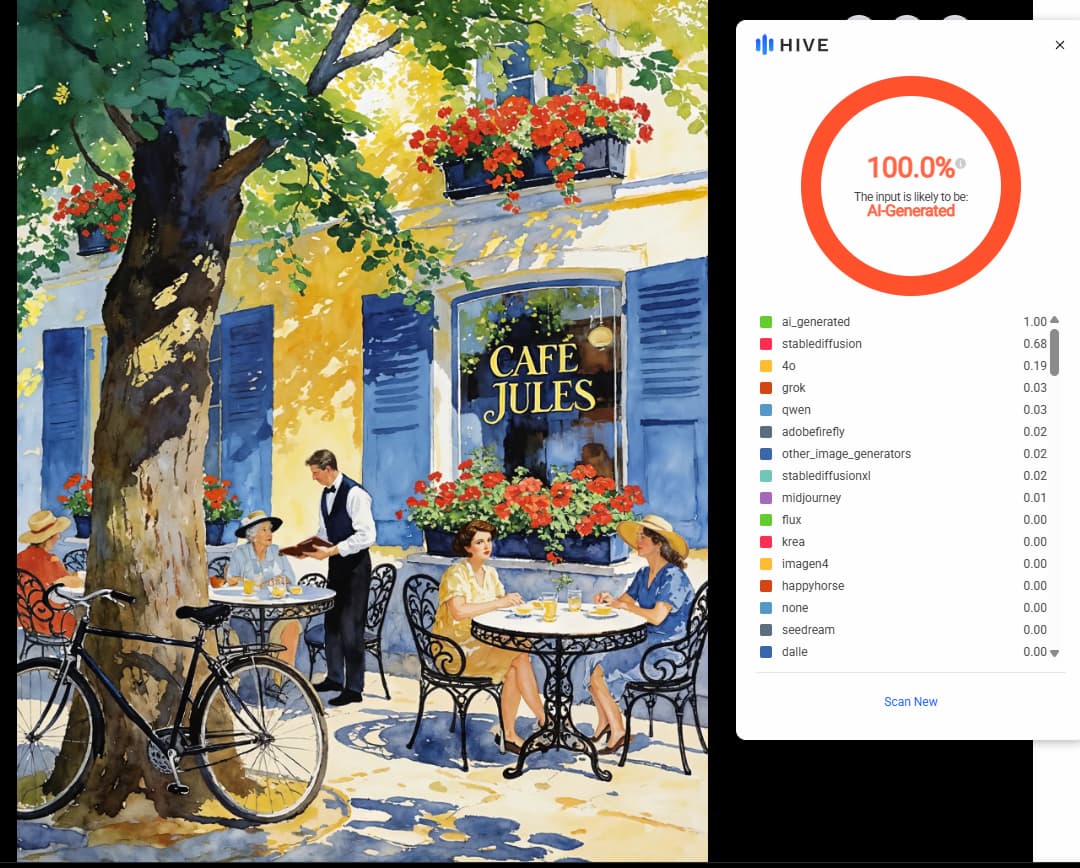
It saddens me to see artists resorting to claiming fully AI-generated images are their own paintings by their own hands. Not because AI images can’t be striking — some genuinely are. Because there’s a quiet dishonesty in it: taking credit for craft that no hand performed. And here’s the irony that ties a bow on it, the one I raised earlier — under U.S. law, the instant they generated those pictures from prompts, they owned nothing at all. They can sign them, stamp them, defend them to the last reply in the thread. The law says they hold no copyright on any of it. They’re claiming authorship of something that, legally, has no author.
So, no — I’m not soft on that. Hold it for a moment, and let me complicate it.
Another artist I know used the same technology in a way that changed how I thought about it. He brainstormed his images in AI — generated them, studied them, treated them the way painters have always treated a reference photo or a thumbnail sketch — and then he picked up his brushes and painted his own genuine work from them. The AI never touched the canvas. It was an idea engine, a way to see a composition before committing pigment to it. I appreciated his approach over the others, and the longer I sat with it, the harder it became to call it anything but legitimate. Painters have worked from references for centuries. The reference simply has a new source.
I should admit I’ve stood on the other side of the prompt myself. Early on, out of plain curiosity, I tried a few of the image generators — Midjourney among them. My attempts were rudimentary. Minimal instructions in, clunky pictures out, nothing like the polished work I’d seen others coax from the same tools. What I took from it wasn’t “anyone can do this.” It was the opposite. Producing genuinely exceptional AI images takes real trial and error and real personal development — a craft of its own, even if it isn’t the craft of the brush. I satisfied my curiosity and chose not to keep at it. But I came away understanding the thing from the inside instead of judging it from the sidelines.
And then there was the man who changed my mind for good.
Early on, I was resistant to AI for all the right reasons. Then one day I came across a painter — a prolific, genuinely exceptional one, decades at the easel — who could no longer work the way he always had. Not the long hours a canvas demands, not the mobility it asks of a body. We don’t know exactly what it was; some mix of the wear that finds a shoulder, a joint, the muscles after a lifetime of the work, enough to close a door he’d assumed would stay open forever. The painting was still in him. The old means of getting it out was gone.
So he spent hundreds of hours — hundreds — learning to make AI images instead. The language of it, the iterating, the correcting, the endless refining, until he could translate the pictures in his head into something he could finally see again outside of it. Work he would never otherwise have had access to. When people call that lazy, I don’t know what to say to them, because I watched the exact opposite: a devotion to craft that found a new path the moment the old one was taken away.
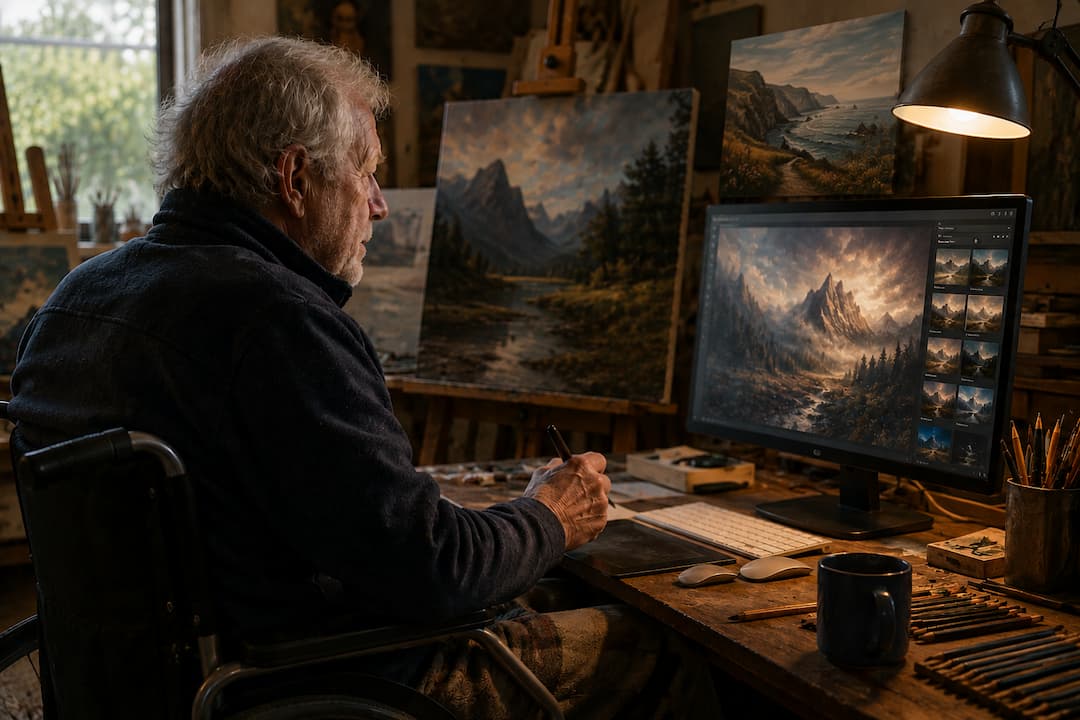
My empathy for his loss allowed me to access an appreciation for what AI has given back to him. I could hold my unease about how these tools were built, and my dismay at the people misusing them, and still not look at that man and call what he was doing a fraud. Because it wasn’t. It was someone finding his way back to the work.
The same can be said of people living with cognitive challenges who use text-based AI to create — to get the words out, to hold a thought still long enough to shape it, to finish something that would otherwise have stayed locked inside. It’s a bigger door than most people realize, and I’ll come back to it. For now I’ll only say this: the very tool one person uses to deceive is the tool another person uses to reach work that injury or illness or circumstance had put beyond their grasp. The tool doesn’t tell them apart. That part is on us.
What you can actually do about it
All of that — the grievances, the spectrum — can leave an artist feeling like the only two options are rage or surrender. They aren’t. There’s a middle ground almost nobody talks about, and it’s made of practical, mostly free tools that put a surprising amount of control back in your hands. I’ve used most of them. Let me walk you through the ones worth knowing.
Start with your own corner of the web, if you have one — a portfolio site, a shop, anywhere your images live under your own roof.
The first and simplest lever is a small file called robots.txt. It’s a plain-text note that sits on your website and tells visiting bots what they may and may not touch, and you can use it to tell the AI training crawlers to stay away from your images. It costs nothing and takes minutes. I found it early, applied it the same day, and felt better for about a week — until I learned its limit. robots.txt is a request, not a wall. The well-behaved bots read the “no” and leave. The badly behaved ones read it and keep right on going. For the polite half of the internet it works. For the rest, you need something with teeth.
That something, in my case, was Cloudflare. If you’ve never heard of it, Cloudflare is what’s known as a Content Delivery Network — a CDN. It routes your website’s traffic through its global infrastructure, which means two things practically: your site loads faster for visitors anywhere in the world, and Cloudflare filters incoming traffic before it ever touches your server. You can set up rules that govern what gets through — blocking traffic from specific regions, throttling suspicious request rates, flagging or stopping bots that behave badly. The right rules depend entirely on your platform, your situation, and what you’re trying to protect, so I won’t prescribe specifics here. But the control it puts in your hands is meaningfully greater than anything robots.txt can offer.
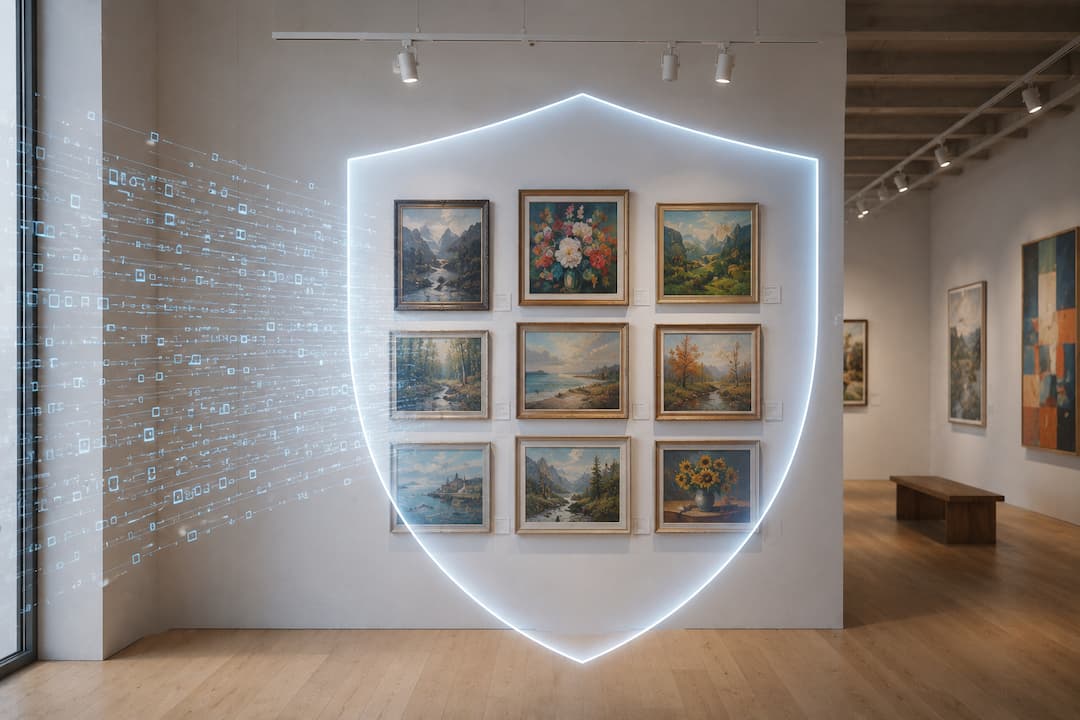
The feature most relevant to this conversation sits in a section called AI Crawl Control. It lets you set individual AI bots to Allow or Disallow — bot by bot, use case by use case. That’s where you draw the line most artists don’t know exists: allow the AI search bots while blocking the AI training bots. The search bots are the ones that let your work surface when someone asks an AI assistant a question — that’s discovery, that’s people finding you. The training bots are the ones quietly copying your images into a database to teach a model to imitate them. With deliberate settings, you can keep the front door open to the first and shut it to the second.
I won’t pretend it was effortless. My site — a WordPress marketplace with hundreds of artists’ images and years of content — has been under near-constant assault for the better part of two years. Denial-of-service attacks, a rotating cast of bad actors whose intentions I could only guess at, one strategy after another, millions of malicious requests in a single stretch. I have a technology background, but I’m not a hardcore techie, and my developer was, in this particular fight, almost no help at all. So I did the very thing this article is supposedly conflicted about: I leaned on AI. I fed it the attack data, the graphs I couldn’t read, the cryptic logs, and I asked it, over and over, what they meant and what rules to write to protect the site — its images, its content, its artists. It took more than a year of trial and error to get the defence where I wanted it. And I’ll put it bluntly: I couldn’t have done it without the help of AI. I used the machine to keep the machines out. If you want a single image for this whole tangled situation, that’s the one.
But a lot of artists don’t run a website. They post to Instagram, to a gallery’s platform, to wherever the audience already is — places where you don’t control the robots.txt and can’t touch Cloudflare. There are tools for you, too.
The most useful is a free service called Have I Been Trained, built by an artist-run outfit named Spawning. You can search it the way you’d search an image library — by your name, or by uploading a piece — and see whether your work has already been swept into one of the giant datasets these models were trained on. It’s a sobering thing to do; plenty of artists discover their life’s work sitting in there, having never once been asked. From the same place, you can add your work to a Do Not Train registry. Be clear-eyed about what that does and doesn’t do: it won’t pull your images back out of a model that already learned from them, and only some AI companies have agreed to honour it. But it’s a real signal, formally recorded, and the roster of companies honouring it is growing rather than shrinking. Some platforms have started building this in directly — DeviantArt, for one, lets artists flag their work as off-limits to training.
Then there’s the tool aimed at the other wound — the one I described earlier, where honest artists get accused of faking. It’s called Content Credentials, and behind it is the Content Authenticity Initiative, a coalition Adobe founded back in 2019 that has since grown to more than five thousand members, from Microsoft and Nvidia to the BBC and most of the major camera makers. Through a free web app, you can attach what amounts to a tamper-evident label to your work — think of it as a nutrition label, or a signature no one can forge — that binds your name, your website, and your social accounts to the image and records how it was made. It isn’t locked to Adobe’s software; it’s built on an industry standard meant to travel across the whole internet. If you’re a painter worn down by strangers in your comments insisting your hand-made work is AI, this is the closest thing yet to proof you can point to. Here is the provenance. Here is the record. Decide for yourself.
I’ll name the wrinkle, because it’s the kind of thing this piece is meant to do: Adobe, the company leading the charge on proving what’s authentic, is the same company building generative AI into Photoshop. Champion of provenance and maker of the machine, both at once. You can read that as pragmatic or as hypocritical depending on where you stand — and my own detection extension flags Adobe-assisted images right alongside the rest, because the line between “edited” and “generated” gets blurrier every month. None of these tools is a fortress. Each one is partial. But partial is a great deal more than the nothing most artists assume they’re stuck with — and nearly all of it is free.
The footprint nobody can agree on
If there’s one corner of the AI argument that has grown loudest this past year, it’s the environmental one — and for good reason. The numbers are real, they’re large, and I’m not going to talk them down to make AI look gentler than it is.
In June of this year, the United Nations University released a report on the environmental cost of all this computing, and the figures are the kind that stop you. In 2025, the world’s data centres drew about 448 terawatt-hours of electricity. If those data centres were a country, they would have ranked as the eleventh-largest electricity consumer on Earth — behind France, ahead of Saudi Arabia. By 2030, that’s projected to climb to 945 terawatt-hours, nearly triple the combined yearly electricity use of Pakistan, Bangladesh, and Nigeria — three countries that are home, together, to more than 650 million people. The water is just as sobering: by 2030 the report projects data centres could consume 9.3 trillion litres a year, roughly the basic annual domestic water needs of every one of the 1.3 billion people in Sub-Saharan Africa. The carbon footprint was around 189 million tonnes in 2025 and is headed toward 400 million. The land they occupy will pass 14,500 square kilometres by 2030 — about twice the sprawl of metropolitan Jakarta.
Read that paragraph twice if you need to. I did. It’s a lot, and anyone who tells you the environmental worry is hysteria hasn’t looked at the figures.
But here’s the part the loudest version of this conversation almost always leaves out, and it changes the shape of the whole thing. In 2025, AI was only about a fifth of that data-centre electricity. A fifth. The other four-fifths is everything else we’ve quietly built our lives on — cloud storage, streaming video, search, social media, the photos backing up from your phone while you sleep. Netflix, Instagram, Google, iCloud: the infrastructure was already enormous, already thirsty, already drawing country-scale power, long before anyone typed a prompt. AI is accelerating the build-out, no question — its share is projected to climb toward 40 percent by the end of the decade. But singling out AI as the villain of the data centre lets an awful lot of the rest of us off the hook for a machine we’ve all been feeding for twenty years.
Even the companies’ own numbers tell that fuller story. Microsoft’s most recent sustainability report shows its energy use up 168 percent since 2020 and its total emissions up about 23 percent — and it attributes the rise to “AI and cloud expansion.” Note the and cloud. Amazon, Google, Meta, and Apple all run vast data-centre footprints that were growing fast before the AI era arrived. As the UN report’s lead author put it, we still treat AI as if it were software when it is in truth “physical infrastructure” — data centres, power plants, cooling systems, transmission lines, chips, minerals, land, and water. It is the most physical thing in the world, and it always was.
AI isn’t floating in the cloud. It is physical infrastructure.
There’s a trap inside the numbers, too, and the report is candid about it: you can’t simply switch to clean power and call it solved. Move a data centre onto renewable electricity and you’ve shrunk its carbon footprint — but you’ve done nothing about the water it drinks or the land it claims, and those burdens tend to land in places that never asked to carry them. Solving one footprint can quietly enlarge another.
I’ll tell you where I land, and it’s a place of more questions than answers. I’ve been near the leading edge of technology since the early 1980s, and I believe in progress; I’m not willing to halt it over a footprint we’re also learning to shrink. I have real environmental concern — but I also have a stubborn, unanswered question about proportion. We are pouring enormous worry into data centres right now. Meanwhile, in Ukraine, oil and gas facilities and pipelines are being deliberately destroyed, with all the environmental havoc that brings. Wildfires are arriving more often and burning fiercer as the planet warms. Scientifically, I genuinely don’t know what is worse — the data centres, AI or otherwise, or the wars and the wildfires. I’m not raising that to dismiss the data-centre problem. I’m raising it because I think it deserves to sit in proportion to everything else we’re doing to the same planet, and it rarely does.
And the picture isn’t static. Real progress is being made on the very footprint the report measures. The clumsy old method of cooling servers with vast moving volumes of air is giving way to liquid cooling that runs hotter and tighter and uses dramatically less power and water. The most striking example I know of is being built in my own backyard. Right here in Metro Vancouver — the Lower Mainland, where I live — Telus is developing a cluster of AI data centres designed around a closed-loop cooling system that, by the company’s account, cuts cooling energy by around 80 percent and water use by roughly 90 percent against a conventional facility, running on something like 98 percent clean BC Hydro power. The detail that caught me: rather than venting its waste heat into the air, the system is meant to recycle it into the local energy grid, warming the equivalent of 150,000 homes. Every electron used twice.
I won’t oversell it. As I write this in 2026 the project is still being built — the first of its facilities are only now coming online — so the full benefit remains a projection rather than a measured result. It is not uncontroversial, either: there are neighbours protesting these facilities, and legitimate worry about water in a region that has already seen restrictions. But it points at something easy to forget in the doom: the engineers are not standing still. The footprint of 2030 is not fated to be the footprint of the machines we have today.
The jobs question, minus the scare tactics
If the environment is the loudest fear in this conversation, jobs is the most personal one. It’s the fear that lives in the body at three in the morning — not “what will become of the data centres,” but “what will become of me.” I won’t downplay that either, because the worry is rational and the change is real.
The alarming surveys are easy to find. Depending on which one you read, somewhere between a sixth and a third of employers say they intend to use AI to reduce their headcount, and there are already real layoffs being pinned, rightly or wrongly, on the technology. Those numbers deserve to be taken seriously. But notice what they are: statements of intention, not records of what happened. They tell you what executives are planning in a slide deck, not what the economy actually delivered. And when you look at the broader forecasts, the picture gets more complicated than the headlines suggest.
The World Economic Forum’s most-cited projection has the world losing about 92 million jobs by 2030 and gaining about 170 million — a net increase of roughly 78 million. I’d hold that loosely; it’s a forecast across every structural force at once, not AI alone, and forecasts are guesses with footnotes. But the shape of it matters, because the dominant pattern the analysts keep seeing isn’t subtraction. It’s churn — old roles dissolving while new ones form, faster than most of us can comfortably track.
The most useful study I came across cuts even finer. Harvard researchers, publishing in early 2026, went through nearly every American job posting from before and after ChatGPT’s arrival. They found that openings for routine, automation-prone work fell by around 13 percent, while demand for more analytical, technical, and creative roles rose by about 20. Read that carefully, because it’s the distinction the scare headlines bulldoze: AI is mostly eating tasks, not workers. A financial analyst still has a job — but the hours that used to vanish into data entry now go to interpretation and judgment instead. The work is being reshaped from the inside far more often than it’s being eliminated outright.
There’s a part of this that falls unevenly, and it deserves to be named plainly. The work most exposed to automation is the routine, clerical, administrative, and service kind, and one United Nations analysis found women’s jobs nearly three times as likely as men’s to sit in the highest-risk category. This transition won’t be shared equally, and pretending otherwise helps no one. It isn’t abstract for working artists, either: most of us don’t pay the rent with our art, we pay it with a day job — and day jobs of exactly that routine, clerical, service kind are the ones now sitting in automation’s path. That’s not a reason to panic. It’s a reason to pay attention, and maybe to start building a second skill before the first one shifts under you.
AI is mostly eating tasks, not workers.
Now let me turn the same skeptical eye on the rosy side of the jobs story — the one the industry loves: “AI is bringing jobs; look at all these data centres going up.” Look closely, and most of that promise evaporates. The construction jobs are real but temporary, often lasting less than a year, while the tax breaks that lured the project last a decade or more. The permanent jobs are startlingly few: even the largest data centres generally employ fewer than 150 people once built, and some as few as 25 — a meaningful share of them security and custodial staff, not six-figure engineers. Divide the public subsidies by the permanent jobs created and you arrive at well over $1 million of taxpayer money per job, by some recent analyses more than $2 million. A 2025 brief from University of Michigan researchers put it about as plainly as it can be put: “Data centers do not bring high-paying tech jobs to local communities.” The build-out is many things. A local jobs engine is mostly not one of them.
And even where genuinely new work appears, there’s a catch the net-positive number quietly hides: the new jobs often demand skills the displaced workers don’t have. A bank teller does not automatically become a machine-learning engineer. “78 million net new jobs” is a comforting figure at the altitude of a spreadsheet and a cold one if you’re fifty-five, your role just dissolved, and your retraining option is a weekend webinar. The aggregate can look survivable while the individual transitions are brutal. Both things are true at once, and good writing has to hold them together.
You can watch an entire country wrestling with exactly this tension right now — my own. In June 2026, Canada launched a national strategy called AI for All, betting big on the optimistic story — some $200 billion in projected growth, 250,000 new AI-related jobs, 90,000 placements aimed at young people — even as one forecast warned the same technology could erase more than half a million Canadian jobs first. The plan is heavy on adoption and literacy, lighter on protection. Critics’ verdict was that it’s “heavy on hype, but light on the right guardrails,” and you don’t have to share anyone’s politics to see the gap they’re pointing at. The upside is real and worth chasing. The guardrails for the people most exposed are the thin part — and the thin part is exactly where the human cost lands.
So where does that leave an artist trying to decide how scared to be? Roughly here: the jobs won’t vanish so much as change shape, and the people who look at the tools with clear eyes will fare better than the people who refuse to look at all. But “net positive” is cold comfort if you’re one of the 92 million, and I’m not going to dress it up. The honest position is the uncomfortable one — that the transition is probably survivable in aggregate and genuinely painful up close, and that the people standing in its path deserve more than a slogan and a free online course.
The misinformation problem, including the kind nobody flags
There is a misinformation problem tangled up with AI, and it’s real. But it has two layers, and the one everybody warns you about — the fakes, the fabrications, the confident nonsense a chatbot will hand you with a perfectly straight face — is not where I want to start. The fakes are real, and I’ll come to how unnervingly good they’ve gotten. First I want to name the layer almost nobody flags: the conversation about AI is itself awash in misinformation, and a good deal of it comes from the very people who believe they’re sounding the alarm.
Scroll your feed and you’ll find it inside a minute. A post leads with a real statistic — a genuine figure from the World Economic Forum, or MIT, or Brookings — and then sprints straight past it into dramatic extrapolation: certainty where the source said “projection,” catastrophe where the source said “maybe.” It is built to be shared, not understood. You can spot the pattern once you know the tells — the urgent tone, the numbers stated as settled fact when they are forecasts with wide error bars, the call to like and follow waiting at the bottom. The sources are often real. The use made of them is not honest.
I can say that with some authority, because writing this article has been one long exercise in catching exactly that. Several of the most alarming figures I started with did not survive a careful look. A water statistic turned out to be wrong. A landmark court ruling turned out to have settled far less than the headlines claimed. Numbers I’d been handed as certainties turned out to be projections with footnotes. None of that means the underlying concerns are fake — it means the sensational version of them is, and the sensational version travels ten times faster than the careful one.
The single distinction that gets bulldozed most often is the one I raised earlier: “AI is replacing tasks” becomes “AI is replacing workers,” and those are not the same sentence. One describes a tool changing how a job gets done. The other announces the end of the job. Collapse the first into the second and you have manufactured panic out of a footnote — which is precisely what a great deal of the doom economy does for a living.
The tool is close to neutral. The habit of mind you bring to it is what decides whether it sharpens you or dulls you.
And it helps to remember that we have been here before, many times over. Socrates worried that writing would ruin human memory. Calculators were going to rot our arithmetic. Google was going to make us shallow; the internet was going to make us lazy. Some of those fears carried a grain of truth — and every time, we adapted, and the terrifying new thing settled into the ordinary old thing nobody thinks twice about. A teacher quoted in a recent NBC News story put it about as well as I’ve heard it: you don’t tear out the hallway because a student runs down it — you teach the student how to move through the hallway. So the better question isn’t whether AI is dangerous in the abstract. It’s whether AI is really different in kind from a Google search, or only in degree. Both hand you something you didn’t know. Both short-circuit a bit of the mental effort you’d otherwise have spent. The tool is close to neutral. The habit of mind you bring to it is what decides whether it sharpens you or dulls you.
Which brings me to the part of all this that genuinely bothers me — and it isn’t the evangelists. It’s the certainty on the other side. One thing that bothers me is how close-minded and how certain so many artists are that AI is pure evil and how hard a line they hold. I understand where it comes from; nearly everything in the first half of this article is a reason to be angry. But a hard line held with total certainty is its own kind of misinformation. It forecloses the questions before they can be asked, and it leaves no room for the painter who found his way back to the work, or the writer with a cognitive challenge who can finally finish a sentence.
I’ll be honest with you, because this piece doesn’t work if I’m not. I am a conflict avoider by nature. I don’t wade into the AI fights online; I watch them, and I keep quiet. And I am cringing at what to expect when I publish this article, because of the hard lines drawn in the sand. I already know some readers will decide, from the title alone, which side I must be on — and be wrong about it. I’m publishing it anyway. Not to win an argument, but because the refusal to pick a tidy side is the most honest thing I have to offer, and somebody in this field ought to be willing to say so out loud.
What AI is actually good for
I’ve spent six sections on what’s broken, stolen, or worth fearing. The truth cuts both ways, though, so here is the harder half for me — the part the 2022 version of myself would have flatly refused to write: what these tools are undeniably good for.
Start with the unglamorous truth the whole shouting match manages to bury. The controversy is almost entirely about image generation — the machine making a “painting.” But for a working artist, image generation is a sliver of what AI actually offers. The quiet, defensible majority of it is text, and the unending administrative weight of being an artist in business for yourself. Drafting an artist statement that doesn’t make you wince. Wrestling a grant application into shape. Writing the exhibition blurb, the pricing research, the gallery research, the social captions you’ve been dreading. Untangling a technical problem nobody around you can solve — my Cloudflare year was exactly that. Brainstorming when you’re stuck. Pushing a paragraph until it finally says the thing. None of that touches a canvas. All of it hands an artist back hours to spend on one. The part of AI most useful to most artists is the part nobody is arguing about.
Then there’s the speed of the thing, which still catches me off guard. The one development that surprises me most is how fast and how far it has come from its early days. Two years ago you could spot an AI image at a glance — the hands gave it away every time, six fingers and a thumb on a smiling portrait. That tell is mostly gone. The polished ones now arrive without an obvious error, and deepfakes, in image and in video, have crossed the line where the average person genuinely cannot tell. Artists are often the exception — a trained eye still catches the wrongness in a shadow or a reflection that everyone else scrolls past — but that’s a thin and shrinking advantage. And I want to hold both halves of this squarely, the way the facts demand: there is real harm being done by some of the people making this work, and at the very same time there is a great deal of good work being made by responsible ones. Both are true. The tool didn’t decide which. The person did.
Here is the part that moved me most, and the reason I stopped being able to hold a hard line. For some people, these tools are not a convenience. They are a door. I told you earlier about the painter whose body closed off the easel after a lifetime at it — AI is how he makes images again. The same is true, quietly, for people living with cognitive challenges who use text-based AI to get the words out, to hold a thought still long enough to finish it, to complete something that would otherwise have stayed locked inside them. When a body or a mind shuts one door, this technology has been, for a lot of people, the thing that opened another. Calling that laziness tells me only that the person saying it has never needed the door.
The tool didn’t decide which. The person did.
The person who pulled all of this together for me is a Vancouver photographer named Kris Krug — his work has run in National Geographic, Rolling Stone, and The New Yorker, so he is no one’s idea of a tech bro chasing a trend. He also runs the city’s longest-running AI community meetup, which has brought thousands of artists, coders, researchers, and educators through the door. What makes him worth listening to is that he refuses the easy team. He marched in Vancouver’s first anti-AI, anti-data-centre protest — and argues, in the same breath, that “shut it all down” and “more compute, trust us” are the same dead end. His community puts Indigenous leaders in the room to build tools that protect language and story and cultural sovereignty rather than strip-mine them. I’ve been on his mailing list since before he turned toward AI, and my own arc went like this: at first I was skeptical, but over time I’ve come to appreciate what he’s doing and how he’s gone about it. It gives me hope.
I’ll keep my eyes open even here, though, because the people offering you the upside usually have a reason. This past spring, Google flew seventy teachers to its California campus to learn its AI tools — and to learn how to win over their skeptical colleagues back home. On its face, useful; most teachers have been handed AI in their classrooms with no guidance at all. But internal company documents, pulled into the open through a court case, describe Google’s work in schools as building a “pipeline of future users,” and the data those students generate as a goldmine to be mined. So take the help when it’s good. Just keep a clear head about who is handing it to you and what they are hoping you’ll become.
It also helps to remember that every tool which widened who gets to make things was called cheating first. Photography was supposed to make painting obsolete; instead it freed painting from the job of merely copying the world, and the Impressionists walked straight through the gap it opened. Photoshop was cheating, until one day it was simply Tuesday. What counts as “original” and “creative” has been argued over for as long as people have made art, and the argument has always, eventually, widened to let the new thing in.
And if you still suspect the whole enterprise is nothing but hype and theft, look where else it has gone while we were fighting about pictures. Researchers at MIT used generative AI to design entirely new antibiotic compounds — molecules that don’t exist in nature — that killed drug-resistant infections, MRSA among them, at a moment when antibiotic-resistant infections take over a million lives a year. A model called EchoNext, trained on more than a million heart scans, outperformed a panel of 13 cardiologists at spotting hidden structural heart disease from a cheap, ordinary ECG — 77 percent accuracy to their 64. Harvard’s popEVE took roughly 30,000 patients with severe genetic disorders that had gone undiagnosed for years — families who had spent those years searching for so much as a name — and reached a diagnosis in about a third of them. In medical research alone, AI has already solved problems we could not. Whatever else is true about it, that is also true.
None of this cancels the grievances. The training was still non-consensual. The footprint is still real. The people passing machine images off as their own brushwork are still doing something dishonest. But a thing can be born in a mess and still do real good in the world — and refusing to see the good, once it’s in front of you, is just the close-mindedness from the other direction wearing nicer clothes.
The bigger picture, and why even an optimist wants guardrails
I’ve shown you the grievances and I’ve shown you the good. The last thing I owe you is the view from higher up — the part of this that’s bigger than any one studio, and the reason that even someone who believes in progress, as I do, should want a brake within reach.
Start with the development that genuinely unsettles me. In June of this year, the company behind the Claude AI assistant, Anthropic, published a report disclosing that more than 80 percent of the code inside its own systems is now written by its AI — up from almost none a year before — and warned that we may be approaching the point where an AI can design and build its own successor, with the humans stepping further back at each turn. The company’s co-founder framed the situation as driving a car that has a gas pedal but no brake, and argued we ought to build the brake before the day we need it. He wasn’t calling for a halt; he was calling for the option to halt to exist — a coordinated, verifiable mechanism that the major players, the United States and China included, would have to agree to together. Be clear-eyed about it: the warning landed the same week the company filed for an enormous public offering, which invites a cynical reading, and the cynics aren’t wrong to notice. But “we should build a brake” and “we intend to keep driving” are not actually contradictory positions, and when the people closest to the engine are the ones asking for a brake, I find it hard to brush them off.
Now step down from the frontier drama, because the daily reality for a working artist is both more mundane and more in your control. The first thing to understand is that “AI” is not one thing — and I don’t only mean its uses, I mean the tools themselves. Behind that little two-letter word is a crowded, wildly uneven marketplace. Some tools are genuinely excellent. A great many are mediocre. Some are junk dressed up in confident marketing. They are not interchangeable, and the gap between the best and the worst is enormous. Treating “AI” as a single product you either swallow whole or refuse outright is a category error. The real task is to shop deliberately, try several, and keep only what actually serves your work.

Which brings me to a caution about money. The prices you see today are not the real prices. The cheap monthly subscriptions are being subsidized by investors racing for market share — the same playbook that made the early ride-share apps feel like a bargain right up until the bill came due. These companies are, by and large, losing money at today’s prices, and as they go public and face pressure to actually turn a profit, the cost is widely expected to climb. The practical lesson for any artist building a workflow around these tools: don’t pour your whole foundation on one company’s product that you don’t own or control. Diversify. Keep your core work portable. There is real competition out there, including open-source models you can run yourself, so you needn’t end up captive to a single platform’s price list.
The part that worries me well beyond my own studio is what all this infrastructure gets pointed at. I don’t feel comfortable with a society becoming a surveillance state, and I believe I’ve read that China is already well down that road. The same tools that help a painter also hand sharper instruments to the people running frauds and attacks. And the guardrails are not automatic — they’re being fought over right now, even among the builders. This past winter, one major AI company refused the terms of a Pentagon contract over two lines it would not cross: no fully autonomous weapon making a lethal targeting decision without a human in the loop, and no mass surveillance of citizens without judicial oversight. For holding that line it was penalized — formally designated a national-security supply-chain risk and cut out of federal contracts — while a competitor accepted broader terms and took the deal. You can read that as principle or as positioning, and the same company does plenty of other defence and intelligence work besides. What it proves is the thing worth knowing: the guardrails don’t install themselves, and exactly where they get drawn is being decided right now, under pressure.
The guardrails don’t install themselves.
Closer to home, you can watch the stakes in something quieter. This spring the Canadian government confirmed it is testing whether AI can help draft the assessment reports written when a person enters federal prison. It is small so far — built on synthetic data, not used on real cases, with human oversight and no final decision made — and the stated purpose is mundane, just helping overwhelmed staff get through mountains of paperwork. But in corrections a report is never only a report. It can shape where a person is housed, which programs they’re assigned, how their risk is judged and their parole prepared, for years. And the concern has teeth: Indigenous and Black Canadians are already badly overrepresented in custody, Canada’s own existing risk tools have already been found by the Supreme Court to risk discriminating against Indigenous prisoners, and an AI trained on that same history could quietly harden yesterday’s bias into a clean, official-sounding profile that’s very hard to argue with. Add automation bias — staff trusting the output precisely because it looks neutral, or because they’re too swamped to check it line by line — and you have a real hazard hiding inside an administrative convenience.
Here is a distinction I want to leave you with, because it cuts through a lot of muddled argument. The environmental debate and the civil-liberties debate are not the same debate. Run that prison AI entirely on Telus’s clean, closed-loop power and a biased profile is still a biased profile. Greening the data centre does nothing about what the data centre is being used to do. Those are two separate questions, and answering one tells you nothing about the other — which is exactly why both deserve their own scrutiny.
All of which is the case for regulation — the thoughtful kind. Not the heavy hand that strangles the genuine promise: the antibiotics, the heart scans, the door reopened for the painter. And not the absent hand that lets the biased profile and the convincing deepfake run loose. The landscape is already shifting underfoot: Canada’s new strategy promises stronger protections against deepfakes, and in the United States, lawmakers in more than 30 states introduced over 300 data-centre bills in just the first months of 2026. The rules are being written right now, unevenly, in real time. Whatever you make of AI, that is a reason to pay attention rather than look away — because the lines drawn in this moment will shape what’s possible for a very long while.
I opened this piece by admitting I can’t find peace with the contradiction at the centre of it. I still can’t. But I’ve come to believe the contradiction is the honest place to stand — and that the worst thing any of us can do right now is decide that it’s simple.
Where that leaves me
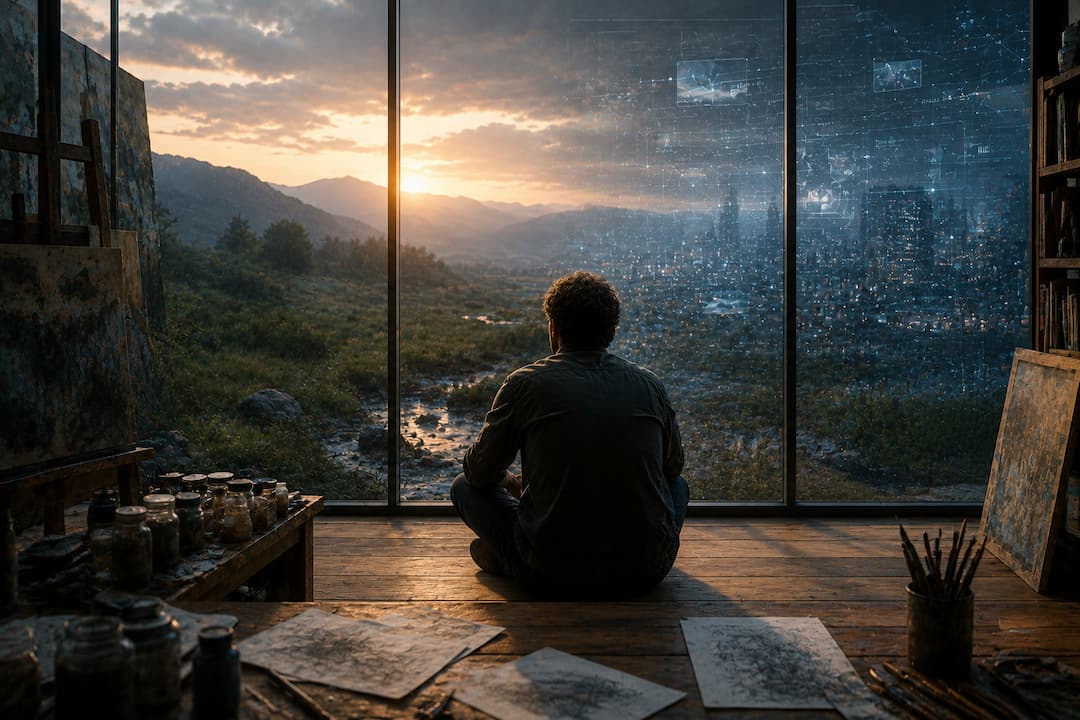
Most mornings I still log in to my Cloudflare dashboard and monitor for any bot attacks. When I find them, I still ask the AI to interpret what it’s seeing and help me adjust the fixes that protect the site. The knot I described at the start of all this is exactly as tight as it was. I haven’t loosened it. I’ve just stopped pretending I can.
Here is the one thing I’ve grown certain of, and it isn’t a side. Eventually, whether we like it or not, AI will be fully entrenched in society. It is not a wave on the horizon we get to vote on; it is already in the water we’re standing in. The painter is already making his images. The prison is already running its test. The machine is already writing its own code. Pretending otherwise isn’t resistance — it’s just looking away.
What I’ve let go of is the myth that there’s a clean answer waiting at the end of all this. Blessing or curse. Theft or gift. Pick a side and the discomfort goes away. But every true thing in this article lives in the space between those poles — the painter who got his work back and the man passing off pictures he never made; the antibiotic that saves a life and the profile that could ruin one; the tool that opens a door and the same tool that picks a lock. The clean answer was never there. The people selling it to you, in either direction, are selling the same false comfort.
So I’ll say plainly what this whole piece has been. I’m not here to change minds. I’m simply here to provide a fuller education into the ins and outs I’ve come to experience over the course of the last three years. You can take all of it, some of it, or none of it. Your conclusions are yours to draw — that’s the whole point.
The question was never whether AI was coming. It came. The only question left is whether you meet it with your eyes open — using what genuinely serves your work, refusing what doesn’t, protecting what matters, and staying awake to the difference.
That’s not fence-sitting. That’s honesty.
One Final Thing
Want artist spotlights, new arrivals, and honest conversations about the art world delivered straight to your inbox? Sign up for the AAA newsletter — no algorithms, just art.
The Arts Artists Artwork store is home to original work from independent artists around the world — browse it to see what our artists are creating and listing, and if you’re interested in selling with us, the Join Us button at the top of the site walks you through everything you need to get your work in front of collectors who are here specifically to find it.


Leave a Reply