

There is a version of art history that moves from masterpiece to masterpiece — the Sistine ceiling, the Mona Lisa, Guernica — and never pauses at the thousands of marks that made those things possible. We see the finished object. We rarely see the thinking that preceded it.
Drawing is where that thinking happens.
Not drawing as a finished art form, though it can be that too. Drawing as the private, relentless, often unexpected process by which artists work out what they actually mean. The sketchbook, the study, the underpainting — these are the places where the hand and the mind are in conversation, each responding to the other in a loop that produces something neither could reach alone.
Leonardo da Vinci understood this better than almost anyone. His notebooks — filled with anatomical drawings alongside flying machines alongside river maps alongside portrait studies — are not a collection of separate interests. They are the record of a single mind thinking in the only language that fully worked for him: the line.
This article is about that process. About what drawing does that language and memory cannot. About the artists who drew their way to understanding, and what we gain when we look at the marks they made before the masterpiece.
What Drawing Does to the Mind
When you draw something, you are not just recording what you see. You are being forced to look at it differently.
A person who has drawn a human hand knows it in a way a person who has only observed hands does not. Drawing demands decisions — where does one finger end and another begin, what happens to the knuckle when the fist closes, how does shadow fall across the palm — that observation alone never requires. The act of translating a three-dimensional form into marks on a flat surface is itself a form of analysis.
Cognitive scientists call this the “drawing effect”: the act of sketching something improves memory retention dramatically compared to simply viewing it. But what artists discovered long before neuroscience confirmed it is subtler than memory. Drawing doesn’t just record a thought — it changes the thought. The hand externalizes what the mind is still forming, and in making it visible, makes it available for examination, revision, and discovery.
The sketchbook is where artists argue with themselves. That is precisely what makes it so generative.
Leonardo da Vinci — Thinking in Lines

No figure in Western art thought more visibly on paper than Leonardo da Vinci. His notebooks — approximately 7,200 pages survive from an estimated 13,000 — are not an artist’s sketchbooks in any conventional sense. They are the record of a mind that could not separate seeing from drawing.
Anatomy, hydraulics, botany, architecture, military engineering, music: Leonardo used the same method for all of it. He drew it. Not to illustrate conclusions he had already reached, but to reach them. The famous cross-sections of the human heart, produced in the early 1500s, were made because Leonardo had obtained bodies for dissection and needed to understand how the organ functioned. He drew what he saw, and in drawing it, developed theories about blood flow that were centuries ahead of their time.
The same is true of the flying machine studies. These are not engineering blueprints in any modern sense. They are thinking on paper — what would happen if the wing were longer, if the membrane were attached here rather than there, if the pilot’s body were positioned differently. Drawing allowed Leonardo to test ideas that could not yet be built.
For Leonardo, drawing was not subordinate to art or to science. It was the method of both. The line was how he learned.
Michelangelo’s Studies — The Body Before the Body

Where Leonardo’s drawing was expansive — branching outward into everything — Michelangelo’s was intensely focused. He drew the human body, thousands of times, from every angle, in every attitude of tension and repose, until he understood it well enough to paint figures on a ceiling 68 feet in the air without the model in front of him.
The preparatory studies for the Sistine Chapel are among the most extraordinary drawings in Western art — not because they are beautiful, though many are, but because of what they reveal about how the ceiling came to be. Figures are drawn from life, then adjusted: the arm raised higher, the torso twisted further, the weight redistributed between the feet. Michelangelo was not copying the body. He was interrogating it.
The great sculptures tell the same story. The marble figures in the Medici Chapel, the various Pietà compositions — these were preceded by months of drawing: studies of musculature and pose, small wax models whose positions were worked out on paper before the chisel touched stone.
Drawing made possible something imagination alone cannot: the ability to test an idea against physical reality, and discover its errors before they were permanent.
Rembrandt’s Sketches — Economy as Intelligence
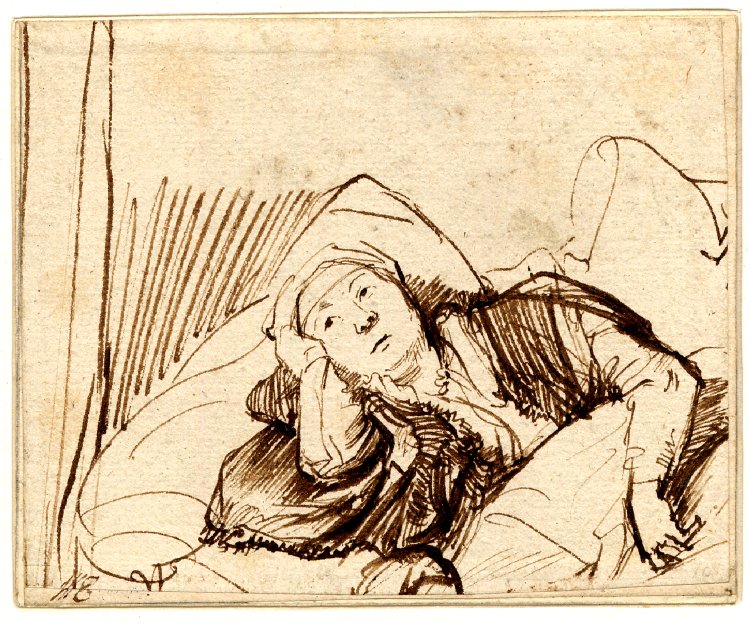
If Michelangelo used drawing to achieve mastery through accumulation, Rembrandt used it to achieve clarity through reduction.
His sketches — done quickly in pen and ink, often in minutes — show a different kind of thinking. Not patient structural analysis, but the rapid capture of a moment before it passes: a woman nursing a child, a man bent under a load, a dog asleep on a doorstep. Where Michelangelo’s drawings are dense with information, Rembrandt’s are astonishing for how little they contain and how much they convey.
This economy is not simplicity. It is the product of a mind that had internalized the human figure so thoroughly it could isolate the two or three marks that held the essential truth of a pose. The shorthand took years to develop. What looks effortless is the result of thousands of hours of looking.
Rembrandt’s quick drawings also served a different purpose than his paintings. They were not direct preparation for finished work. They were practice in seeing — a habit of looking that kept the eye sharp and the hand responsive. He drew constantly throughout his life not because each sketch had a destination, but because drawing was how he stayed alive to the world around him.
Constable’s Cloud Studies — Drawing as Scientific Observation

In the summer of 1821 and 1822, John Constable went outdoors almost every day and drew clouds.
Not casually. Systematically. He dated each study, noted the time of day, recorded the wind direction and strength, and described the weather conditions in writing on the back of the paper. His cloud studies are among the earliest examples of sustained meteorological observation in Western art — produced not in service of any specific painting, but as a project of understanding.
Constable believed that painters of landscape had been getting clouds wrong for centuries, treating them as decorative backgrounds rather than as dynamic, constantly-shifting phenomena. The only way to get them right, he concluded, was to study them the way a scientist studies anything: systematically, repeatedly, under different conditions.
His finished paintings — the great Constable skies over the Stour Valley and Salisbury Cathedral — are among the most atmospherically convincing in Western art. They are the direct product of this drawing practice: not imagination, not convention, but accumulated observation. What Constable demonstrated is that drawing can be a form of research, a method for understanding the natural world that painting, with its demands of composition and finish, cannot serve as efficiently.
Turner’s Sketchbooks — Volume as Practice

Joseph Mallord William Turner filled more than 300 sketchbooks during his lifetime. He carried them everywhere — on tours of Britain, Switzerland, Italy, the Rhine — and filled them with drawings that ranged from meticulous architectural studies to rapid impressions of light on water made in seconds before the moment changed.
What the volume of Turner’s sketchbooks reveals is something that becomes obvious once stated but is easy to underestimate: mastery is cumulative. Each sketch built on the last. The ability to capture a particular quality of coastal light in three confident strokes was not a gift. It was the result of having attempted to capture that light hundreds of times before, in dozens of places, under varying conditions.
Turner’s sketchbooks also functioned as an archive of experience. He drew things he would return to years later, finding in an old notebook a form or a quality of light that now connected to something he was working on. The sketchbooks were not just practice. They were memory — in a form more precise and more retrievable than words.
The Underpainting — What Lives Beneath the Surface

Drawing in the Western tradition did not stop at the edge of the paper. It continued beneath the surface of finished paintings.
The underpainting — sometimes called the imprimatura, or in its drawn form, the underdrawing — was the structural armature that held a finished painting together. Artists drew the composition onto the support in charcoal or chalk, or laid it in with a monochrome paint layer, before colour work began. This preparatory stage resolved the essential questions: where figures sit in relation to each other, how light falls, what the large masses are — before colour, which is harder to revise, entered the picture.
Modern X-ray and infrared imaging has revealed what these foundations looked like beneath some of the most celebrated paintings in Western art. Vermeer’s figures, so apparently effortless in their light-filled rooms, are underlaid with careful adjustments — a window moved, a figure repositioned, a shadow reconsidered. Van Eyck’s panels show extraordinarily detailed underdrawings in a fluid, confident hand, suggesting a draughtsman mapping out every inch of the composition before paint began.
What these X-ray images confirm is that the luminous surface of a great painting is not where the thinking happened. The thinking happened in the drawing beneath.
Picasso’s Studies for Guernica — Drawing as Moral Reckoning
On April 26, 1937, the German Luftwaffe bombed the Basque town of Guernica during the Spanish Civil War. Within days, Pablo Picasso — who had accepted a commission to produce a large mural for the Paris World’s Fair — had his subject.
What followed over the next six weeks was one of the most intensely documented creative processes in twentieth-century art. Between May 1 and June 4, Picasso made approximately 45 preparatory studies for the final painting, working in pencil, oil, and gouache. He tested the composition obsessively, discarded entire versions and returned to abandoned ideas, and argued with himself on paper about what this image needed to be.
The studies reveal a painting discovering itself. The screaming horse — central to the final composition — appears early, but in different positions and different attitudes of anguish. The mother with her dead child went through multiple versions before Picasso found the pose that made her grief universal rather than particular. The figure holding the lamp moved around the composition in study after study before settling at the top of the final canvas.
If Guernica had been painted directly, without this process, it would have been a different painting — and almost certainly a lesser one. The drawing process was not preparation for the moral reckoning. It was the moral reckoning. Picasso was working out, mark by mark, what outrage and grief looked like when distilled to their visual essence.
The Digital Age and What Drawing Risks Losing
Digital tools have transformed the drawing practice of working artists. Tablets and styluses respond to pressure, angle, and speed. Layers allow revision that paper never permitted — a form can be adjusted without restarting, a composition shifted without redrawing the whole. These are genuine gains, and many artists use them to produce work of extraordinary quality.
But something in the shift is worth naming.
Paper resists. The friction of graphite against cartridge paper, the way ink bleeds into laid paper, the moment when a chalk mark travels further than intended and the drawing has to find a way to accommodate it — these accidents are often where drawings become most interesting. The irreversibility of a mark on paper creates a pressure that shapes how artists draw: more decisively, with a higher commitment per stroke.
Digital drawing is infinitely revisable, which is also to say infinitely forgiving. Whether that forgiveness produces different thinking is a question each artist has to answer individually. Many working artists — including those who work digitally for finished pieces — maintain separate paper sketchbooks specifically for the quality of thinking that physical drawing produces. This is not nostalgia. It is recognition that different tools produce different results, and that the particular combination of resistance and consequence that paper offers has not yet been fully replicated.
Why the Sketchbook Still Matters
Artists who maintain a consistent sketchbook practice today describe it in terms that echo what Leonardo, Rembrandt, and Constable were doing five centuries ago: it is a place to think, not to perform.
The sketchbook is private in a way that finished work is not. It is not made for exhibition, not for sale, not for anyone else’s opinion. This changes what happens in it. Ideas that feel too incomplete or uncertain to commit to canvas can be tested without consequence. Connections between apparently unrelated things — a remembered pose and a light effect noticed yesterday, a compositional problem and an accidental mark — can be made and pursued or abandoned freely.
What develops through sustained sketchbook practice is not just skill, though skill does accumulate. What develops is a visual vocabulary: a set of images, forms, gestures, and marks that belong specifically to that artist and no one else, built through the private accumulation of thousands of hours of looking and drawing.
The finished work — the paintings, the sculptures, the prints — is where that vocabulary goes public. The sketchbook is where it is built.

Conclusion: Learning to See the Marks
The next time you stand in front of a great painting — in a museum, in a reproduction, on a screen — try to hold in mind what preceded it.
Behind the luminous surface of a Vermeer interior is a drawn composition worked out in an underpainting. Behind the athletic figures of the Sistine Chapel ceiling are thousands of chalk studies of bodies drawn from life. Behind Guernica’s compressed anguish are 45 drawings in which Picasso worked out, mark by mark, what grief and outrage looked like.
The finished work is where the thinking arrived. The drawing is where it happened.
This is what drawing, at its most essential, is: not a preliminary to art, but a mode of understanding — a way of looking at the world so closely, so repeatedly, and with such commitment of hand and eye, that you come to know things you could not have reached any other way.
The sketchbook is not the work. It is what makes the work possible.
Explore Original Art at Arts Artists Artwork
If this article has deepened the way you see what goes into a finished work, we invite you to carry that appreciation into browsing the original art available on our site. Every piece in our collection was made by a working artist — someone who knows what it is to think through a sketchbook, to revise, to commit.
Browse original artwork at artsartistsartwork.com.
And if you’d like more writing on art history, the creative process, and the stories behind the work, sign up for our newsletter. We publish new articles regularly and share them with our subscribers first.
Leave a Reply