

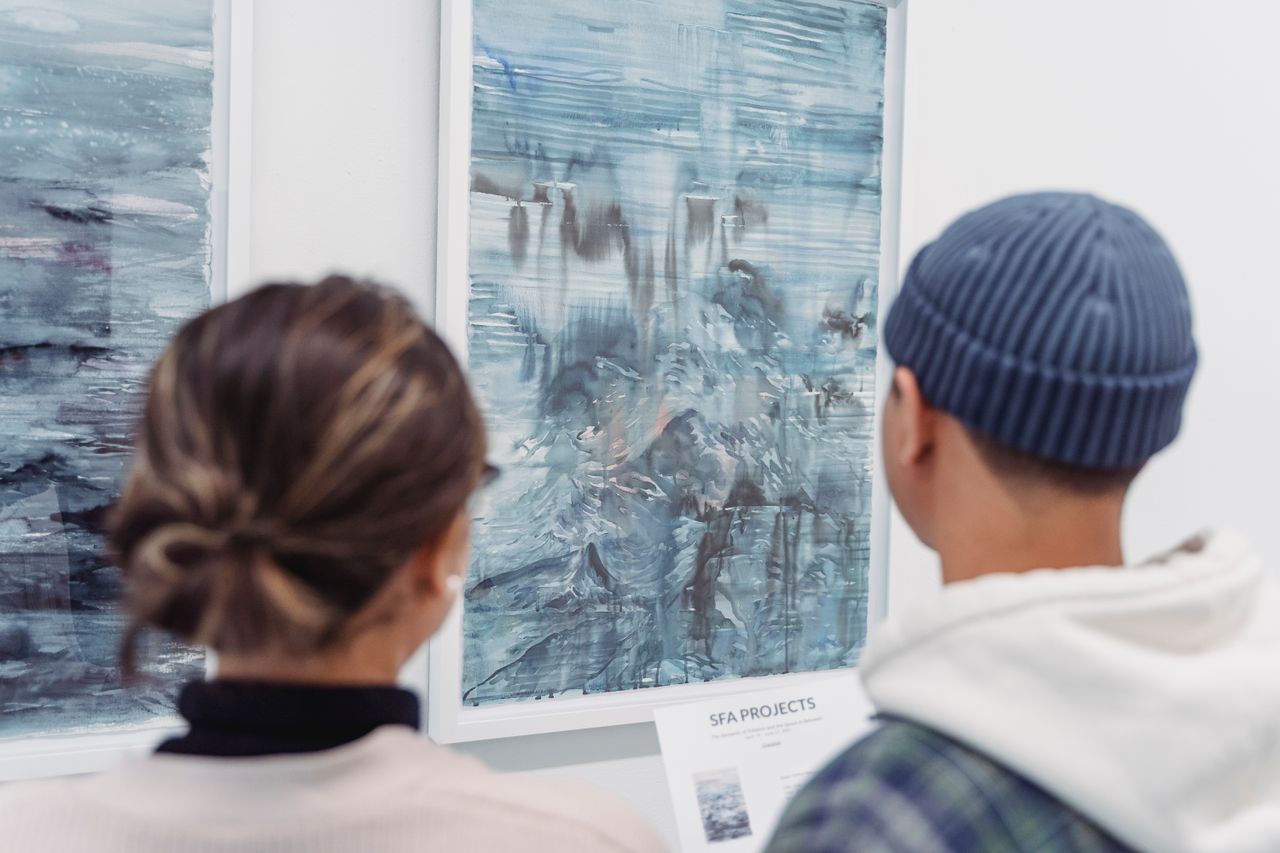
There is a moment that happens more often than most artists ever know about.
Someone encounters a painting online — scrolling through a feed, browsing a gallery website, moving through a marketplace — and something about it slows them down. They look longer than they intended. Maybe they read the title. Maybe they go back and look again. They don’t leave a comment. They don’t click an inquiry button. They don’t do anything an artist would recognize as meaningful.
And then they close the tab and go about their day.
But the painting stays with them.
This is where art interest actually begins for many collectors, and it is almost entirely invisible to the people who made the work. Understanding this stage — its texture, its pace, its particular fragility — may be one of the most underappreciated skills in the business of making and selling art.
The Signal Problem
Artists are trained, by necessity, to watch for signals. A price question is a signal. A direct message is a signal. A purchase is the clearest signal of all. Everything else tends to get filed under something vague — reach, engagement, awareness — categories that feel good but don’t translate into action in any obvious way.
This is understandable. Running an art practice is demanding, and it’s natural to orient attention toward what is measurable and actionable. When someone asks about a painting’s dimensions, something has shifted. When someone fills out a contact form, the channel is open.

But this orientation, reasonable as it is, creates a significant blind spot.
It treats interest as something that either crosses a threshold or doesn’t — as though the journey from first encounter to eventual purchase were a light switch rather than a slow tide. Research into online art buying behaviour consistently shows that collectors visit multiple platforms and return to the same work several times before making contact — a pattern that is almost entirely invisible to the artists involved. And for a meaningful portion of people who ultimately do buy art, that journey is long, quiet, and happens mostly without any visible signal at all.
Understanding what the collecting journey actually looks like from the inside makes clear why: the path from first encounter to first purchase is rarely as direct as artists tend to assume.
The artist, watching for the switch to flip, doesn’t see the tide coming in.
How Interest Actually Moves
Consider what the experience looks like from the other side.
Someone discovers an artist’s work — perhaps through a shared post, perhaps through a search, perhaps because a friend mentioned a name. The initial encounter produces something they don’t immediately have words for. That emotional response is more complex than it might appear — art activates something personal and often pre-verbal, which is part of why the journey toward a purchase can take so long. Not “I want to buy this,” necessarily. More like: this is doing something to me and I’m not sure what.
They might return to the work a few days later to check whether the feeling is still there. Sometimes it isn’t — the spell breaks on a second look, and that’s the end of it. But sometimes it is still there, maybe even more pronounced. They look at other pieces by the same artist. They read the bio. They try to understand the work a little better.
At some point, they might imagine the painting in a specific room. Above the fireplace. On the wall across from where they read. This is actually quite far along in the process. But it’s also where retreat most often happens — the imagining makes the purchase feel suddenly real. That hesitation is incredibly common among first-time buyers, and understanding it helps artists respond with patience rather than pressure.
This retreat isn’t rejection. It’s the work becoming serious to someone.
If that person returns a third time — weeks later, months later — something different is happening. They’re not just browsing. They’re checking back on something that has claimed some portion of their interior life, and they’re trying to understand what to do with that.
Eventually, if conditions are right, the inquiry comes. The message is sent, the question is asked, the purchase is made. But what looks from the outside like a fairly sudden decision has often been quietly underway for a long time.
What Artists Tend to Miss
Most of this journey is conducted in private, and most of it generates no data that artists ever see.
The thoughtful comment, when it comes, is often read as encouragement rather than as information about where someone is in a process. The returning visitor to a website goes uncounted as an individual. The person who has looked at a painting seventeen times over the course of two months looks identical, in aggregate numbers, to someone who clicked once by accident.
This isn’t a technology problem, exactly. It’s a structural feature of how art interest moves. It’s slow, it’s recursive, it’s emotionally complex, and it happens mostly in the private space of someone’s imagination and attention.
What it means practically is that a significant portion of the interest that exists around an artist’s work at any given moment is completely undetectable to that artist. Data from the Art Basel and UBS Global Art Market Report consistently shows that transactions at the lower and mid-market level are growing even as high-end sales fluctuate — meaning more collectors are making decisions quietly and independently, outside of traditional gallery relationships. There are people right now, for almost any artist with any meaningful online presence, who are somewhere in that quiet journey — looking, returning, imagining, retreating, considering.
They haven’t announced themselves. They may never announce themselves. But they are not nothing.

The Infrastructure of Return
If interest of this kind is quiet and slow and operates largely without signals, the question becomes: what does it need to continue?
The honest answer is not very much — but what it needs, it needs consistently.
It needs a place to return to. A website that is well-organized, that loads properly, that makes it easy to move through the work without friction or confusion. Getting that foundation right matters more than most artists realize — not because it converts browsers into buyers directly, but because it keeps the door open for the person who isn’t ready yet. This sounds basic because it is basic, but a surprising number of artist websites create small obstacles — clunky navigation, inconsistent image quality, incomplete information — that don’t stop a determined buyer but do quietly interrupt the rhythm of someone who is still in the earlier, more tentative stage of interest. That person was not yet committed. The obstacle gives them a reason to disengage that they may not even consciously register.
It needs the work to keep appearing — not in a pushy or sales-driven way, but in the ordinary way that a working artist’s output does appear. Staying visible in the current algorithmic environment is its own challenge, but the principle holds: rhythm and presence are what keep quiet interest alive. For someone who is quietly tracking an artist’s work, this rhythm is essential. It gives them something to return to. It keeps the relationship alive without requiring anything from them.
It needs some form of continuity that doesn’t depend on the person remembering to come back. An email list is still, for this purpose, one of the most underestimated tools available to working artists. Artwork Archive makes the case well: unlike social media, where algorithms determine who sees what and when, an email list is an audience you own and control — something The Abundant Artist has long argued is still more powerful than any paid promotion. Not because it drives immediate sales — though it can — but because it removes the requirement for a potential collector to remember to return. The work appears in their inbox. The thread of interest is preserved. The person who found a painting three months ago and hasn’t quite known what to do with that feeling gets a quiet reminder that the work is still there, still available, still being made by a real person.
This is not marketing in the aggressive, funnel-driven sense. It’s closer to maintenance — keeping the lines of connection open so that interest, which moves on its own timeline and cannot be rushed, has a pathway back when it’s ready to become something more.
Patience as Practice
There’s something worth saying about the emotional dimension of all this for artists.
The model of art interest that most of us absorb from the broader commercial world is built around relatively short cycles. Interest peaks, a decision is made, the transaction happens. The whole process is designed to be quick. Urgency is manufactured when it doesn’t arise naturally, because in most contexts, a prospect who is not moving is a prospect who is leaving.
Art doesn’t fit this model. A piece of work can stay in someone’s peripheral awareness for a year before something shifts and the time feels right. A painting bought during a moment of life transition — a new home, a milestone birthday, a season of feeling more settled — may have been seen and half-considered years before. The purchase feels sudden from the outside. The interest was anything but.
Artists who take the long view tend to do better over time — and what actually works in the current environment tends to confirm that: sustained presence and genuine connection outperform short bursts of promotional effort. They think about the person who hasn’t made contact yet not as a missed opportunity but as someone whose interest is still in motion, still developing, and who may need nothing more than time and the continued availability of the work.
This is a different kind of patience than simply waiting and hoping. It’s an active patience — sustained presence, consistent quality, steady rhythm — that holds the door open without demanding that anyone walk through it on any particular schedule.
What This Asks of Artists
None of this requires dramatic changes. It doesn’t demand that artists become marketers or build elaborate content strategies or transform the way they think about their practice.
What it does ask is a slight shift in how interest is understood — away from the binary of visible signal and silence, toward a more graduated sense of the landscape of attention that exists around the work.
Some of that attention will never become anything. That’s true of every artist’s audience. People encounter things that move them and don’t act on that for reasons that have nothing to do with the work — financial constraints, the wrong moment, life simply being complicated.
But some of it will eventually become something. And the conditions that make that possible are mostly within an artist’s reach: work that is findable and well-presented, a rhythm of presence that doesn’t require anything from the viewer, and some form of ongoing connection that keeps the channel open.
The person who is quietly considering a painting doesn’t need to be persuaded. They’re already partway there. They just need the work to still be findable, the artist to still be making things, and time to do what it sometimes quietly does.

Arts Artists Artwork is an online art marketplace and publishing platform dedicated to connecting collectors and art lovers with exceptional artists from around the world.
Sign up to our Newsletter for more great articles on art history, the art market and business of art and more.
Leave a Reply