

A post has been making the rounds lately, the kind that stops you mid-scroll because it says the quiet part out loud. An artist described feeling inspired but stuck — full of something, yet unable to find the shape for it. The mediums that used to feel like an extension of her hands didn’t feel right anymore. She wasn’t sure anyone else understood the feeling. Within hours, dozens of people had liked it, and more had left comments. Clearly, a lot of people understood it fine.
That post could have been about any number of things — a painter who suddenly can’t stand the smell of oils, a writer who stares at a blank page that used to fill itself, a potter whose hands know the motions but whose heart isn’t in the clay. The specifics change. The ache underneath doesn’t. And one of the most experienced working artists alive today happened to answer it, in four sentences that are worth sitting with far longer than it takes to read them.
But before we get to her answer, it’s worth naming what we’re actually talking about — because “creative block” is not one thing. It wears a lot of different faces, and the advice that helps with one kind can be useless, even harmful, for another.
The Many Faces of Being Stuck
Skill outgrowing the medium. Sometimes the problem isn’t inspiration at all — it’s that your hands have learned more than your current tools can hold. A technique that once felt expansive now feels like a box. This isn’t failure. It’s often the first sign that you’re ready for something you haven’t found yet — the same restlessness that shows up when an artist returns, again and again, to a subject that never quite lets itself be finished.
Burnout wearing the mask of block. This is the one that fools people the longest. The well isn’t dry — it’s exhausted. Somewhere along the way, making became indistinguishable from producing, and producing became indistinguishable from proving. The creative instinct doesn’t disappear in burnout. It goes quiet because it’s tired of being treated like a machine.
Life catching up with practice. People change. Grief reshapes what feels true to say. A move, a loss, a birth, an illness — these things don’t ask permission before altering what you need to make and why. Sometimes the block isn’t about art at all; it’s that the artist has changed and the practice hasn’t caught up yet.
Fear dressed up as perfectionism. The gap between what’s in your head and what ends up on the canvas can feel unbearable, especially for anyone who has tasted real skill. Comparison sharpens the gap further. This kind of block often isn’t a lack of ideas — it’s a refusal to let anything less than the imagined version exist in the world.
The quiet, ordinary dry spell. And sometimes nothing is wrong at all. Creativity has seasons, and not every season is a growing one. Winter isn’t a malfunction of the tree.
Different causes call for different responses — burnout needs rest, not discipline; fear needs permission, not technique. But there is one artist whose advice manages to speak to nearly all of them at once, because it isn’t really about fixing the block. It’s about changing your relationship to it.
An Artist Who Has Earned the Right to Say It Simply
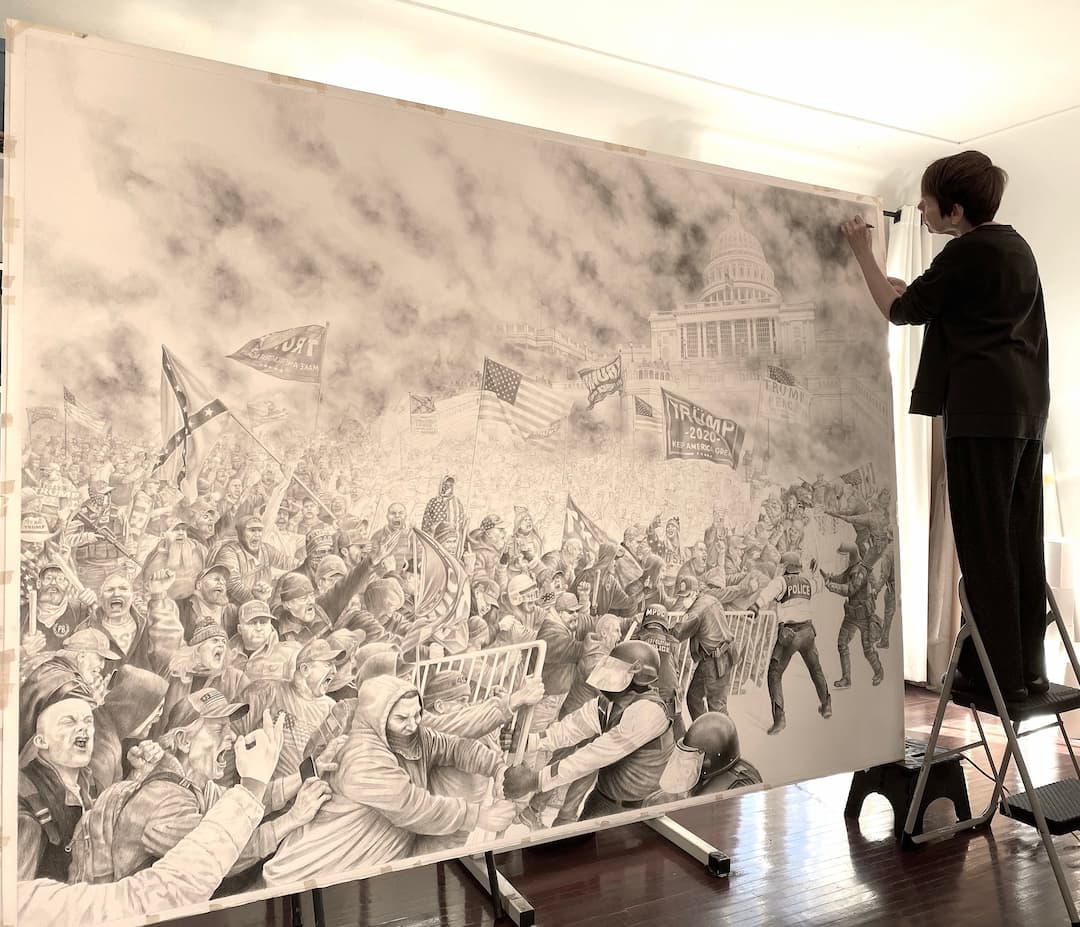
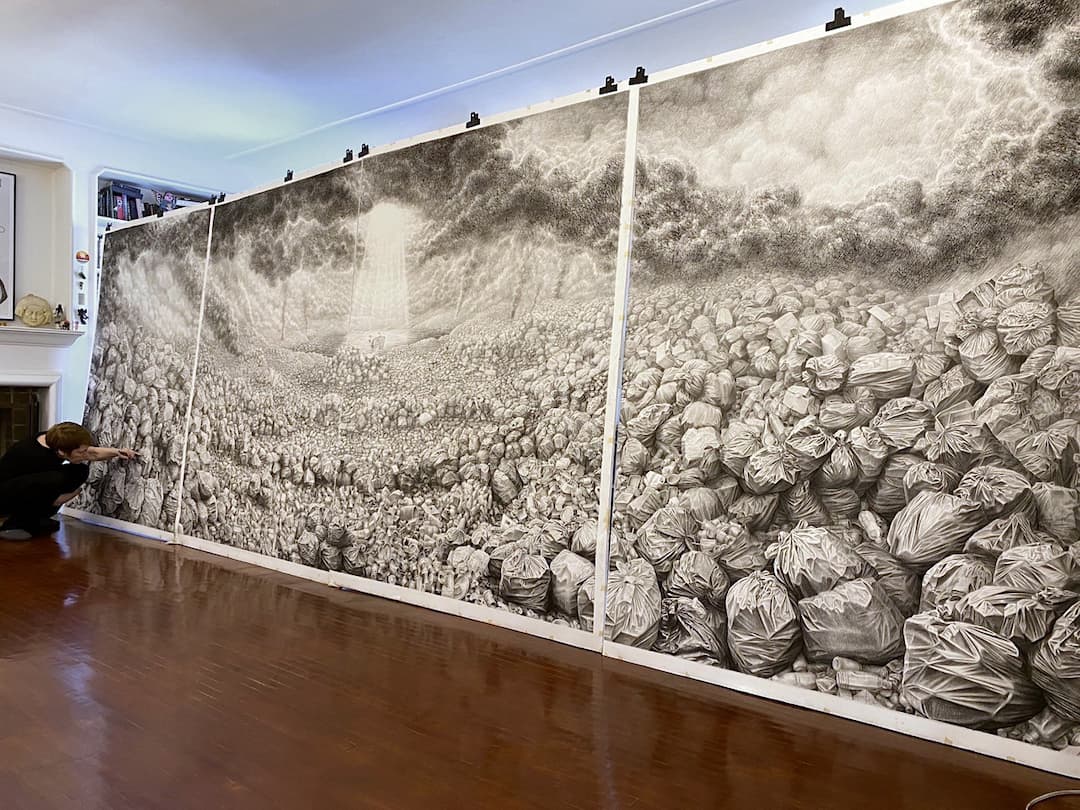
Laurie Lipton has been making art for more than fifty years. She’s known for extraordinary, obsessively detailed graphite drawings — large-scale, hand-rendered worlds built one small mark at a time, the kind of work that takes not just skill but a particular species of patience most people never develop. A photo accompanying her reply shows her mid-work: standing on a ladder in front of a drawing that dwarfs her, pencil in hand, still climbing into the work after all these decades.
When the artist’s post reached her, Lipton responded on Threads that what she has found helpful is stopping: stop pushing, stop forcing, stop struggling, just stop. Her advice was to go out, to museums, to galleries — to look, absorb, and be open. She reassured the artist that they are not stuck, only needing to shift to another plateau and move forward, ending with the encouragement to trust that they will.
Four sentences. No technique, no prompts, no five-step framework. Just permission — from someone who has clearly earned the right to give it.
What She’s Actually Saying
It’s worth slowing down on what’s really being offered here, because it runs counter to almost everything creative culture tells us to do when we’re stuck.
Stop the forcing. Most advice about creative block assumes the solution is more effort — push harder, show up daily, grind through it. Lipton says the opposite. Struggling against a block often just deepens the groove of the struggle itself. Stopping isn’t giving up. It’s recognizing that force was never the ingredient that was missing.
Go be filled, instead of trying to empty yourself. Somewhere along the way, many artists absorb the idea that inspiration has to be generated from the inside, alone, under pressure. Lipton suggests the reverse: go out into the world and let it fill you. Museums, galleries, looking at what other people have made — these aren’t procrastination. They’re maintenance. A well doesn’t refill itself by being asked to give more, and the same is true of stepping outside the studio altogether, where the world does some of the filling for you.
Trust the plateau. Maybe the most important shift in her answer is the reframe itself. Not stuck — moving toward a new plateau. A plateau isn’t a wall. It’s a resting place before the next climb, and every long career has several. Lipton isn’t offering a technique for getting unstuck. She’s offering a different story about what being stuck even means — not a verdict on the work, but a phase inside it.
Trust That You Will
The original post gathered dozens of likes and a long thread of comments, which says something on its own: this isn’t a rare experience. It’s close to universal among people who make things — and it tends to arrive quietly, without warning, often right after a period of real growth.
There’s no framework here, no checklist, nothing to buy or master. Just an artist who has been stuck more times than she could probably count, still standing on a ladder in front of an enormous drawing after fifty years, telling you what actually helped.
Stop pushing. Go look. Trust the plateau.
Trust that you will.
If you’re in the looking-and-absorbing phase right now, our art store is a good place to spend some of it — a wide range of working artists, all finding their own way through the same plateaus. And if you’d like more reflections like this one, along with new work from AAA artists, delivered straight to you, sign up for our newsletter.

Leave a Reply