

Yayoi Kusama spent much of her life trying to make the infinite visible.
She painted fields of tiny loops that seemed capable of continuing beyond the edge of the canvas. She covered rooms and bodies with dots until individual forms began to disappear. She used mirrors to multiply light, colour and the viewer’s own reflection into spaces that appeared to have no beginning and no end.
On August 14, 2026, Kusama’s own remarkable life came to an end. She died at a hospital in Tokyo at the age of 97, although the news was not publicly announced by the Yayoi Kusama Museum and Yayoi Kusama Foundation until August 27.
The announcement carried an especially fitting detail. Kusama had continued painting until her final days.
For an artist whose career stretched across more than seven decades, perhaps there could have been no more appropriate ending.
Today, Kusama is one of the most recognizable artists in the world. Her pumpkins, polka dots and Infinity Mirror Rooms attract enormous crowds. Her work has crossed from museums into fashion and popular culture, while images from her installations have circulated around the world through social media.
It would be easy, then, to remember Yayoi Kusama simply as the woman with the dots.
Her story is far more extraordinary than that.
She was a Japanese woman who entered the overwhelmingly male New York avant-garde of the late 1950s. She worked alongside artists who would become giants of postwar American art. She staged provocative performances, experimented with sculpture and installation, wrote novels and poetry, lived openly with serious mental health challenges, endured periods when the international art establishment largely moved on without her, and then experienced one of the most remarkable late-career rises in modern art.
To understand Kusama is to look beyond the dots and into the ideas behind them: repetition, infinity, anxiety, sexuality, obliteration, nature, love, death and the uneasy place of the individual within an immense universe.
A Childhood Filled With Patterns
Yayoi Kusama was born on March 22, 1929, in Matsumoto, a city in Japan’s mountainous Nagano Prefecture. Her family operated a successful seed nursery, placing flowers and plants among the visual surroundings of her childhood.
But Kusama’s childhood was not an easy one.
She later described a deeply troubled family environment and began experiencing vivid perceptual disturbances while still young. Flowers could seem to speak to her. Patterns appeared to spread across surfaces and engulf her surroundings. Dots and repeated forms could multiply until the distinction between herself and the world around her seemed to disappear.
These experiences became inseparable from the visual language she developed as an artist.
That distinction matters. Kusama’s polka dots were not originally conceived as a clever trademark or decorative device. Repetition offered her a way to give physical form to experiences that could otherwise be frightening and difficult to communicate.
Plants also remained important throughout her career. Flowers would reappear in paintings and eventually as enormous sculptures and immersive environments. In our exploration of the evolution of flower paintings, we looked at how artists repeatedly reinvent one of art history’s oldest subjects. Kusama pushed that reinvention into another realm entirely, turning familiar organic forms into strange, monumental environments.
Even as a young woman, however, she wanted something larger than the artistic world available to her in postwar Japan.
Georgia O’Keeffe and a Journey Toward America
One of the most remarkable episodes in Kusama’s early life began with an act that aspiring artists today might recognize immediately: she contacted an artist she admired.
That artist happened to be Georgia O’Keeffe.
Kusama found O’Keeffe’s address at the American Embassy and sent her a letter along with some of her watercolours, asking for advice about establishing herself in the United States. O’Keeffe responded.
For a young Japanese woman hoping to enter the American art world in the 1950s, the encouragement mattered.
Kusama left Japan in 1957, initially spending time in Seattle before establishing herself in New York. She reportedly arrived carrying a large body of works on paper that she hoped could help support her financially.
The move was audacious.
New York was becoming one of the centres of the international art world, but opportunity was hardly distributed equally. Kusama was entering a scene dominated by men, working in a country whose wartime conflict with Japan had ended only a little more than a decade earlier. She was also trying to establish herself without the financial security enjoyed by some of her contemporaries.
Yet she arrived with enormous ambition.
Soon, she began making work that was difficult to ignore.
The Infinity Nets
In New York, Kusama developed the paintings that became known as her Infinity Nets.
From a distance, some appear almost monochromatic. Move closer and the surface reveals itself as an extraordinary accumulation of small painted loops repeated again and again across enormous canvases.
There is no obvious centre. No single mark demands attention. Instead, thousands of marks become a field.
Kusama could repeat this gesture obsessively for hours, creating paintings whose scale seemed to challenge the physical limits of both artist and canvas. The repetition suggested something capable of continuing forever.
This was very different from the heroic gestures associated with Abstract Expressionism, which had dominated New York during the previous decade. Where an artist such as Jackson Pollock made movement dramatically visible, Kusama could make the individual gesture almost disappear through repetition.
The Infinity Nets also introduced an idea that would remain central to her art: the tension between the individual and the infinite.
One mark is distinct.
Repeat it thousands of times and individuality begins to dissolve.
That idea would eventually move off the canvas and consume entire rooms.

Inside the New York Avant-Garde
Kusama’s New York years placed her near several movements that were transforming art: Minimalism, Pop Art, performance, installation, conceptual practices and the counterculture of the 1960s.
She knew artists including Donald Judd and Joseph Cornell. Judd, before becoming internationally celebrated for his own Minimalist work, was an early admirer of Kusama’s Infinity Nets. Cornell became a close friend.
Kusama was never easily contained within one movement.
Her repeated forms could resemble Minimalism, yet their origins were intensely personal. Her use of mass-produced objects intersected with Pop Art, yet repetition for Kusama carried psychological meanings very different from the cool commercial imagery associated with artists such as Andy Warhol.
Her soft sculptures complicated matters further.
In works such as Accumulation No. 1, ordinary furniture became covered with repeated stuffed protrusions. Familiar domestic objects became strange, obsessive and unsettling.
Kusama later argued that ideas she pioneered appeared in the work of better-known male contemporaries, including Warhol and Claes Oldenburg. The precise questions of influence and appropriation remain debated by art historians, and claims of direct copying should therefore be treated cautiously.
The larger historical context is less controversial.
Women, Asian artists and others outside the dominant networks of the Western art establishment frequently struggled to receive recognition equal to that of white male contemporaries. Kusama’s career belongs within that larger reassessment of who was visible, who was remembered and who was written into art history.
It is something we have explored before in Breaking Barriers: Women Artists Who Transformed the Art World. Kusama was not alone in having to fight for space in a story too often written around men.
Sex, Protest and the Happening
Anyone who knows Kusama primarily through museum exhibitions of pumpkins and mirrored rooms may be surprised by just how provocative her work became during the 1960s.
She entered the world of happenings and performance art, organizing events involving nudity, body painting, political protest and sexual liberation.
During her Body Festivals and Anatomic Explosions, Kusama painted participants with polka dots, extending the pattern from objects and canvases onto human bodies. Some events protested the Vietnam War. Others challenged conventional attitudes toward sexuality and public behaviour.
These weren’t the actions of an artist trying to make attractive objects for comfortable living rooms.
Kusama was deliberately testing boundaries.
She understood publicity, too. Her happenings generated attention at a time when she was still fighting to establish herself within a competitive art world. Artist, organizer, performer and self-promoter became overlapping roles.
Yet beneath the spectacle was an idea that had been present in her work for years.
She called it self-obliteration.
When the Self Disappears
Self-obliteration may be the key that unlocks much of Yayoi Kusama’s work.
Imagine a red dot painted on a white wall. It remains clearly separate from everything around it.
Now cover the entire wall in dots.
Continue onto the floor.
Cover the furniture.
Cover a person’s clothing and skin.
At some point, the boundaries separating wall, object and person begin to break down. Everything becomes part of the same repeated visual field.
Kusama used repetition in precisely this way.
The individual could be absorbed into something larger. The self might disappear into an endless universe of repeated forms.
That can be beautiful, frightening or both.
It also helps explain why the dots, nets, mirrors and repeated objects across Kusama’s career should not be treated as separate gimmicks. They are different expressions of questions she returned to relentlessly.
Where does the self end?
Where does the universe begin?
And what happens when the boundary between them disappears?
Mental Illness Without the Myth of the “Mad Genius”
Kusama spoke openly about hallucinations, anxiety and obsessive thoughts, and any serious account of her work must acknowledge their importance.
But this part of her story requires care.
Art history has a long habit of romanticizing mental illness, particularly when discussing famous artists. Suffering becomes transformed into evidence of genius, as though illness itself produces great art.
That idea can be both inaccurate and harmful.
Kusama’s mental health experiences influenced her imagery and her artistic processes because she repeatedly said they did. That does not mean mental illness explains her talent.
Talent also required discipline, intelligence, experimentation, persistence and an astonishing capacity for work.
After returning permanently to Japan in 1973, Kusama voluntarily entered a psychiatric hospital in Tokyo in 1977. She continued living there while maintaining a studio nearby and sustaining an intensive creative practice.
That part of her life can challenge another stereotype: that serious mental illness necessarily ends a person’s ability to create, work or build a meaningful life.
Mental illness can profoundly affect someone’s life without becoming the total definition of that person. That is a subject explored from a lived-experience perspective in Rebuilding Self-Trust After Mental Health Challenges.
For Kusama, treatment and creativity were not opposites. She created a structure in which both could exist.
Art remained part of how she lived.
The Artist the Art World Almost Left Behind
From today’s perspective, it can seem inevitable that Yayoi Kusama would become famous.
It wasn’t.
When she returned to Japan, the extraordinary international celebrity of her later decades was still far away. Her prominence within the Western art world diminished, even though she continued creating visual art and expanded her work into literature, including novels and poetry.
This is one of the most important parts of the Kusama story because art history can look deceptively orderly in retrospect.
We see famous names in museums and textbooks and assume their importance was always recognized.
It often wasn’t.
Artists disappear from dominant narratives. Tastes change. Critics move on. Galleries close. Movements are simplified into a handful of convenient names. Gender, race, nationality, geography, money and access to influential institutions can all affect whose work remains visible.
Then history sometimes looks again.
For Kusama, that reassessment gathered momentum through exhibitions in the late 1980s and early 1990s. A major turning point came in 1993 when she represented Japan at the Venice Biennale.
The international art world was rediscovering an artist who had been there all along.
Kusama was in her sixties.
Her greatest global fame was still ahead of her.
Pumpkins, Mirrors and Infinity
The pumpkin became one of Kusama’s most recognizable motifs, but her attachment to pumpkins went back to childhood. She described them with affection, finding their forms humorous, generous and reassuring.
Under Kusama, the humble squash became monumental.
Pumpkins appeared in paintings, prints and sculptures, often covered in her unmistakable dot patterns. Giant versions eventually occupied museums and public spaces around the world.
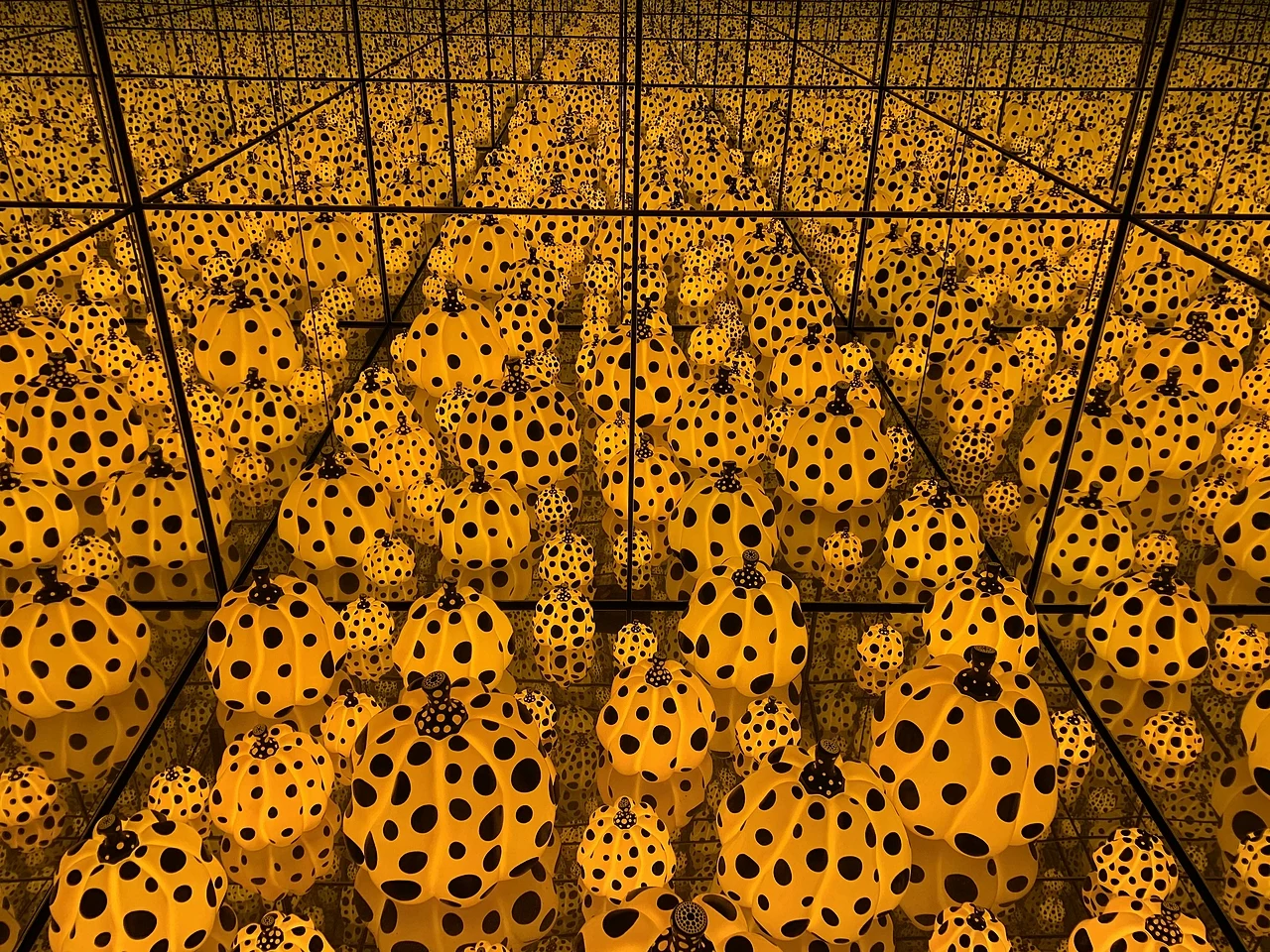
But nothing transformed Kusama’s public recognition quite like her Infinity Mirror Rooms.
The idea was not new.
Kusama created her first mirrored environment, Infinity Mirror Room—Phalli’s Field, in 1965. Mirrors allowed something she had previously suggested through painting and repeated sculpture to become spatially overwhelming. Reflections multiplied forms beyond the physical boundaries of the room.
Decades later, audiences would line up for the experience.
Step inside one of these installations and you no longer stand safely outside an artwork looking at it.
You enter it.
Your own reflection becomes another repeated element. Lights seem to recede into impossible distances. Walls cease to behave like walls. A relatively small physical room can suddenly suggest endless space.
Installation art changed the relationship between artwork and audience by making physical experience part of the work itself. As we’ve discussed in our broader exploration of modern and contemporary art, artists increasingly moved beyond traditional painting and sculpture to create environments, experiences and ideas.
Few artists made that transition as accessible to the public as Kusama.

When the Avant-Garde Became a Global Phenomenon
There is a fascinating contradiction in Kusama’s later career.
The woman who once staged radical happenings and struggled for recognition eventually became an international cultural institution.
Museums mounted major retrospectives. Visitors waited in long lines to enter her installations. Her work commanded enormous prices. Collaborations with fashion brands carried her dots into luxury retail and popular culture.
The Yayoi Kusama Museum opened in Tokyo in 2017.
Social media accelerated the phenomenon.
Infinity Mirror Rooms were almost perfectly suited to the age of Instagram: spectacular, immersive, colourful and immediately recognizable in photographs. Millions of people who might never have encountered an Infinity Net painting became familiar with Kusama through mirrored rooms, giant pumpkins and fields of dots.
That popularity occasionally produced criticism. Were people experiencing the art, or merely photographing themselves inside it?
Perhaps both.
There is an irony here Kusama herself might have appreciated.
An artist who spent decades exploring the disappearance of the individual created installations in which millions of individuals desperately wanted to photograph themselves.
Yet popularity should not be confused with superficiality.
The selfie came later.
The ideas came first.
More Than the Polka-Dot Lady
Extreme recognizability can become its own kind of trap.
Once an artist develops an image the public instantly associates with their name, everything else can disappear behind it.
Van Gogh becomes sunflowers and a severed ear.
Dalí becomes melting clocks.
Warhol becomes soup cans.
Kusama becomes polka dots and pumpkins.
But her career included painting, drawing, collage, sculpture, installation, performance, film, fashion, fiction and poetry. She worked across movements without fully belonging to any of them.
She also kept returning to the same fundamental concerns without simply repeating the same artwork.
Infinity could be painted.
Then sculpted.
Then performed.
Then reflected.
Then inhabited.
That consistency may be one reason Kusama became so recognizable. Her art changed dramatically while the underlying visual language remained unmistakably hers.
For working artists, there is something worth noticing in that. A recognizable artistic voice does not necessarily require making the same thing forever. Kusama demonstrated how a core set of ideas can be explored through radically different materials, scales and experiences.
A More Complicated Legacy
Kusama’s extraordinary artistic legacy is also accompanied by a troubling part of her history that deserves acknowledgment. Passages in her fiction and autobiography included racist and stereotypical descriptions of Black people, sometimes portraying them as primitive, hypersexual or threatening. The writings attracted renewed scrutiny in 2023 ahead of her Infinite Love exhibition at the San Francisco Museum of Modern Art.
Kusama subsequently apologized, saying she deeply regretted using hurtful and offensive language and that her intention throughout her life had been to promote love, hope and compassion. SFMOMA condemned the anti-Black sentiments while continuing with the exhibition, arguing for an approach that neither erased an important artist nor ignored troubling aspects of her history.
There is an uncomfortable complexity here. Kusama herself navigated an American art world in which being Japanese and female could place her outside the dominant circles of power. Experiencing marginalization, however, does not prevent someone from carrying prejudices of their own.
Acknowledging this does not require dismissing Kusama’s contributions to art history, nor does recognizing her artistic achievements require overlooking things she wrote. Both belong to the historical record. Understanding influential artists sometimes means resisting the temptation to turn complicated human beings into either heroes or villains.
What Yayoi Kusama Changed
Trying to assign Kusama to one movement ultimately diminishes what made her important.
She intersected with Pop Art without simply being a Pop artist. Her repetition anticipated concerns associated with Minimalism without sharing all of Minimalism’s philosophy. Her happenings belonged to the development of performance art and the 1960s counterculture. Her environments helped push installation art toward the immersive experiences now commonplace in contemporary museums.
She also occupies an important position in the history of Asian artists working internationally after the Second World War.
The Smithsonian American Art Museum has described her as among the first artists from Asia to achieve global prominence in the postwar period. That achievement becomes more remarkable when we remember that her global prominence was neither immediate nor continuous.
Kusama’s story also belongs to the ongoing reconsideration of women in art history.
Again and again, art historians have returned to periods they thought they understood and discovered that important women were present but inadequately represented in the stories subsequently told about those periods.
Artemisia Gentileschi had to be reclaimed from centuries of neglect. Berthe Morisot’s central role in Impressionism was often overshadowed by male colleagues. Recognition of artists such as these has helped expand our understanding of what art history actually was, rather than merely repeating the narrower version inherited from previous generations.
Kusama lived long enough to witness that reconsideration happen to her own career.
Fame Arrived, but the Work Never Stopped
There is something especially striking about Kusama’s later years.
She had already achieved what most artists could scarcely imagine. Her exhibitions attracted hundreds of thousands of visitors. Her imagery was recognized around the world. Major museums collected and exhibited her work. Her name had entered popular culture.
She could have stopped.
She didn’t.
The Yayoi Kusama Museum’s announcement of her death said she continued painting until her final days, never setting aside her brush.
That detail transforms the way we might look at her extraordinary late-life fame.
The fame was enormous.
But apparently, the work still mattered.
At 97, after more than seven decades of making art, Yayoi Kusama was still an artist making art.
An Artist Who Saw Infinity
Death creates a strange boundary in an artist’s story.
Until it happens, the work remains open-ended. Another painting may come. Another exhibition may change our understanding. Another unexpected direction remains possible.
Now Yayoi Kusama’s body of work is complete.
Her influence is not.
She helped expand the possibilities of painting, sculpture, performance and installation. She challenged assumptions about who could occupy the centre of the international avant-garde. She turned deeply personal experiences into a visual language understood around the world. She survived periods of obscurity long enough to see the art establishment reconsider her importance.
And somehow, she made infinity something people could walk into.
Perhaps that is why the familiar dots deserve one last look.
A single dot is small. Almost insignificant.
Place another beside it, and another, and another. Allow them to spread beyond the canvas, across the walls, over objects and bodies, into mirrors and through reflected space.
Eventually there are too many to count.
The individual mark disappears, but the pattern continues.
Yayoi Kusama died in Tokyo on August 14, 2026, at the age of 97.
The artist who spent a lifetime imagining things without endings finally reached one.
The dots go on.

Discover the Artists Creating What Comes Next
Yayoi Kusama’s story reminds us that art history is not something that exists only in museums or belongs only to artists whose names we already know. Every generation has artists experimenting, developing their own visual language and creating work without knowing where that journey may eventually lead.
At Arts Artists Artwork, you can discover original work by living artists from around the world and support them while they are still here to experience that support. Whether you’re an experienced collector or simply looking for something that speaks to you, browse our art store and spend some time discovering the artists creating today.
And if stories like Kusama’s deepen your appreciation for art and the people who make it, sign up for the Arts Artists Artwork newsletter. We share our latest art history articles, artist stories, insights for working artists, and new discoveries from across our creative community.
Leave a Reply