

It’s eleven at night, and someone is on their knees on a concrete floor, taping the corner of a bubble-wrapped canvas. The tape won’t sit right in the cold. There’s a drive in the morning — six hours, maybe more — to a fair they applied to eight months ago, paid a fee to enter, and won’t know if it was worth it until Sunday afternoon. The dog needs to be dropped at a neighbour’s. The van still needs loading. Tomorrow’s weather looks like rain, which means a tarp, which means finding the tarp, which is somewhere behind the boxes they haven’t unpacked since the last show.
None of this is painting. None of it will show up on the finished piece hanging on a wall a few weeks from now, priced, framed, waiting for someone to stand in front of it and decide whether they love it enough to bring it home.
But it happened. It always happens. And almost nobody who buys the finished piece ever sees it.
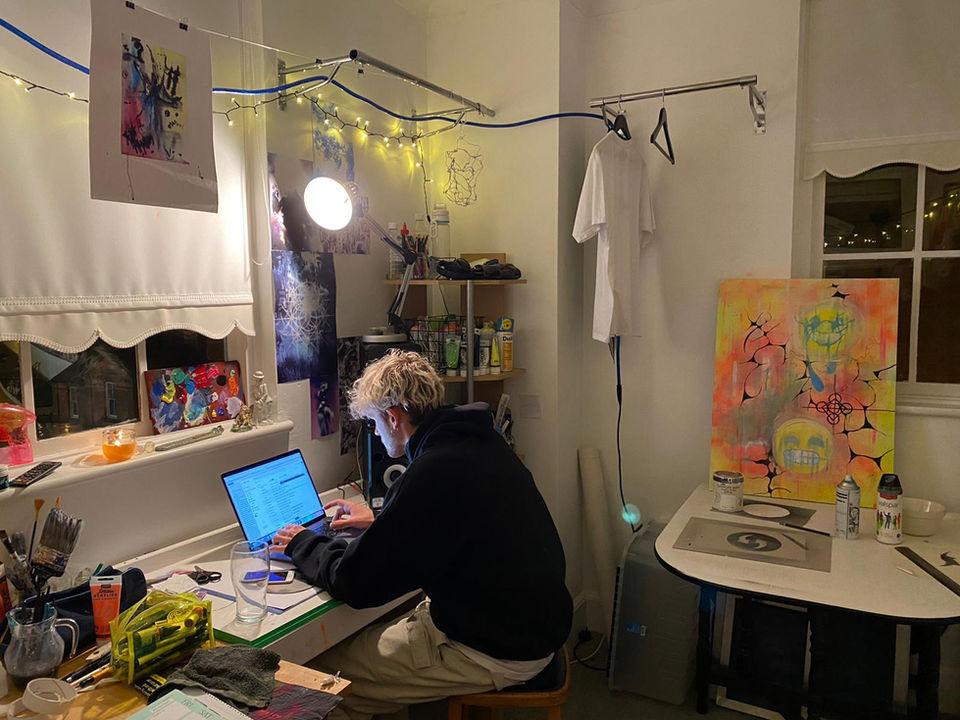
The Part Nobody Sees
There’s a reason for that gap in understanding, and it isn’t collector indifference — it’s that the labor genuinely is invisible by design. A recent national survey of more than 2,600 working artists, conducted by NORC at the University of Chicago with support from the Andrew W. Mellon Foundation, set out to answer a question that turns out to have never really been answered before: what does an artist’s working life actually look like? One of the researchers behind it put it plainly — artists have functioned as something close to an invisible labor force, absent from the kind of data that shapes how the rest of us understand any other profession. We have decades of statistics on what a nurse’s week looks like, or a contractor’s, or a teacher’s. Artists have mostly had to describe their own working conditions to each other, informally, because no one else was asking.
That absence of data isn’t neutral. It’s part of why the price on a piece of art can feel, to a buyer standing in front of it, like a number pulled out of the air — untethered from anything you can point to and say, ah, that’s what this cost to make. When you don’t know what stands behind a price, you have nothing to measure it against except your own gut feeling about what art “should” cost, which is usually a feeling shaped by mass production, not by the actual economics of making one thing by hand.
So let’s look at what actually stands behind it.
What a Week Looks Like
Start with the website. Every listing, every image, every price — built and rebuilt as marketplaces change their formats, as new platforms appear and old ones stop mattering. Photographing the work itself is its own discipline: getting the color right so a screen doesn’t lie about a painting’s actual blues, getting the lighting even, learning software most artists never wanted to learn.
Then the submissions. Juried shows require an entry fee — paid up front, before anyone has said yes — and the odds are not generous. Most applications end in a form-letter no, and the ones that end in yes come with a deadline, a shipping requirement, sometimes a crate that has to be built to spec. Doing this once is a small task. Doing it a dozen times a year, absorbing a dozen small rejections along the way and not letting any of them reshape how you see your own work, is a discipline most people never have to practice.
Then the road. Loading a van, driving to a fair or a gallery opening, standing behind a booth for two or three days making conversation with strangers who might buy something and might just be looking, then packing it all back up and driving home — often to unload straight into a studio where the next body of work is waiting, unstarted, because the last two weeks went to this instead.
And running under all of it: the marketing. Saatchi Art’s 2022 Artist Report, drawn from thousands of working artists selling through their platform, found something that sounds almost contradictory until you sit with it — many of these artists are effectively working two full-time jobs at once: one making the art, and a second one promoting it, with most of that second job’s hours going into social media and digital marketing that most buyers scroll past without a second thought.
None of this is the exception. It’s the baseline. It’s what “being an artist” actually requires, underneath the part with the paintbrush — a pattern we’ve written about before in You’re Not Failing: Artists Have Always Had Day Jobs, because it isn’t new, and it isn’t a sign that anyone is doing it wrong. It’s just what the job has always asked of the people who do it.

What Changes When You Know This
Here’s the thing about this kind of information: it isn’t meant to make anyone feel guilty for asking a fair question about price. Buyers are entitled to ask what something costs and why. The point isn’t guilt — it’s respect. It’s the difference between looking at a price tag and thinking that seems like a lot for a painting, and looking at the same tag and understanding that it represents a submission fee that didn’t pan out three times before it did, a website rebuilt twice, a week of a fair that barely broke even, and hundreds of hours nobody itemizes on an invoice because there’s no line for “the work before the work.”
“Expensive” and “worth it” are different measurements, and they don’t always move together. Something can be expensive relative to what you’d casually spend on décor and still be, once you know what it took to exist, genuinely worth it. We’ve written more about how to hold that distinction as a buyer in Art You Love vs. Art That Matches Your Couch and How to Buy Art Without Feeling Out of Your Depth — and if you’re an artist reading this too, What Galleries Know About Collectors That Artists Don’t goes further into that same gap from the other side.
There’s a related gap worth naming too. In When Art Is Everywhere, What Makes Us Want to Own It? we wrote about how easy it’s become for artists to be seen, and how little that has to do with whether anyone actually buys. Loving something and owning it live in different parts of a person. Understanding the work behind a piece is one of the things that can close that distance — it’s what turns I like this into I want this one, specifically.
Knowing what stands behind a piece doesn’t obligate you to buy it. But it does change what you’re looking at. You start to see the finished painting the way you’d see the tip of something much larger — because that’s what it is.

Why They Do It Anyway
Ask most artists why they keep going through all of this — the fees, the rejections, the van loaded at midnight — and you won’t usually get an answer about money, because for most of them, the numbers alone would never justify it. You’ll get something closer to: I couldn’t not. Something in them needs to make the thing and needs, just as much, to see it land in front of another person’s eyes. The work before the work is the price of admission for that moment — a stranger standing in front of a painting, going quiet, feeling something they didn’t expect to feel.
That’s the part worth protecting. Not by romanticizing the hardship — there’s nothing romantic about taping a box shut at eleven at night in the cold — but by seeing it clearly, and letting that clarity change how we value what artists make.
Every piece in our shop carries a week like this behind it, even the ones that look effortless. If you’d like to see what that work actually produced, browse the art shop and see it for yourself.
And if you’d like more where this came from — artist features, art history, collecting guides, and the occasional piece like this one — sign up for our monthly newsletter.
Leave a Reply